


At one point or another, the vast majority of adults in the industrialized world have experienced heartburn. Some more frequently than others. Many people I know approach taking antacids and PPIs (like Nexium and Prilosec) like it’s a daily multi-vitamin.
It is such a regular practice, I think some people just assume heartburn is a feature of normal life. That the pills they are popping are like brushing their teeth.
This is wrong.
In fact, the entire mainstream framework for understanding and treating heartburn is wrong. This is precisely why it seems to persist, no matter how many PPIs or antibiotics people take. Sure, they may provide some temporary relief…but eventually, it comes back. And then, gets worse.
This article is intended to function as a complete guide to stopping heartburn and reversing the damage it has caused. Therefore, I cannot spend real estate explaining all the manner in which the mainstream medical paradigm is wrong. I’ve already written several articles doing just that.





Instead, let us focus on what this article entails:
Chapter 1 - Heartburn and its consequences.
Chapter 2 - The many causes of heartburn.
Chapter 3 - Immediate relief of symptoms.
Chapter 4 - Reversing the damage.
Chapter 5 - Preventing the return.
Chapter 6 - A new experimental protocol.
Chapter 1 - Heartburn and its consequences
Simply put, heartburn is a sensation. That nagging feeling of burning or irritation in your chest and up along your throat. Sometimes that includes a poor or metallic taste in your mouth.
By using the term heartburn, we presume that it is associated with “acid reflux” - which is the movement of stomach acid up into the esophagus. But, this is incomplete. Some of these symptoms could just as easily be manifestations of a heart attack. In fact, many heart attacks are undiagnosed because people mistake the symptoms for something else.
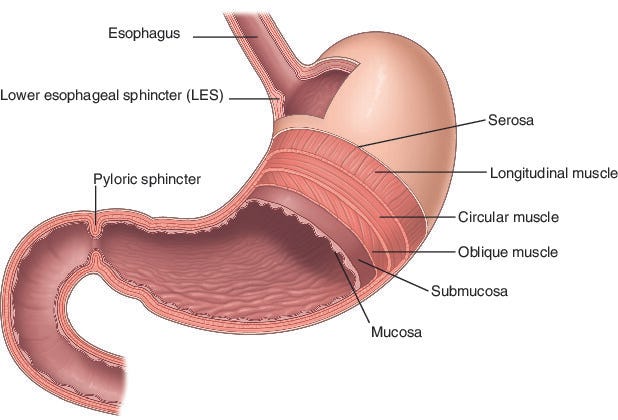
Near the top of the stomach is a band of muscle called the lower esophageal sphincter (LES), which regulates passage of food between the esophagus and stomach. At the other end is the pyloric sphincter, which serves the same function between the stomach and duodenum. These sphincters are regulated by a combination of neural, hormonal and mechanical signals.
The highly acidic environment of the stomach helps break down the large and complex macromolecules that you swallow. The stomach is extremely acidic (low pH), almost to the degree of battery acid.
With respect to digestion, the acidity is ideal for breaking down food and activation of the digestive enzyme pepsin. It is likely that the reflux of stomach acid into the esophagus causes damage not on its own, but by activation of pepsin. The pepsin then proceeds to digest the lining of the esophagus.
When the stomach is digesting and releasing more acid, this low pH is a signal that keeps the LES closed - so that the contents of the stomach do not move up into the esophagus.
Which brings us to an critical point: acidic content in the esophagus is bad…but, it does not mean that ‘high stomach acid’ is the cause of the reflux.
In fact, it is low stomach acid (high pH) that leads the LES to remain open and reflux the contents of the stomach - including pepsin.
The constant irritation of the esophagus can cause many consequences, including:
a change in the mucosal cells that is not ideal for its function
a transformation of the mucosal cells to some other kind (dysplasia)
continued degeneration of the cells to something that is cancerous
inflammation and eventually ulcers, which bleed
Ulcers can ultimately perforate, which can be fatal
But, heartburn is also part of a spectrum called peptic ulcer disease, which can also impact the duodenum - a part of the tract that comes after the stomach, past the pyloric sphincter.
At this point, people will be screaming in their heads “he didn’t mention H. Pylori! The cause of peptic ulcer disease!”
Quite right. Because after many years, I am more inclined to believe that the proliferation of H. Pylori is a symptom, rather than a cause.
That is to say, the chronic dysfunctional environment of the stomach leads to growth of the H. Pylori population - which in many people is present in small amounts, normally. For H. Pylori to proliferate, the stomach pH has to go up above its normal level. So, to target H. Pylori as a “root” cause is misguided.
Chapter 2 - The Many Causes of Heartburn
Heartburn does not have one cause. It doesn’t even have a few causes.
It’s got a boatload of causes. Many of which converge on a couple of common pathologic mechanisms. To get a good sense of the causes, I would highly recommend reading the Root Cause essay linked above.
Suffice it to say, digestion is an incredibly involved and complex process. And so, the causes are appropriately vast.
Digestion begins before we even take a bite of the food we desire. Digestion is impacted by the food itself. Highly processed and unnatural foods can be harder on the stomach or intestines to digest. Not to mention the inflammation that processed foods cause.
A lifestyle that includes poor scheduling of meals can cause heartburn. Similarly, the environment we eat in can cause heartburn. Overfilling the stomach with food causes heartburn. Inappropriate mixing of foods and drink also contributes.
Other disease, like diabetes, can cause heartburn by slowing the movement of food through the gastrointestinal tract.
Herniated discs in specific locations in the spine can cause heartburn. Similarly, poor breathing habits can cause heartburn due to their impact on certain nerves (e.g. Vagus or Phrenic) in the back of the chest and abdomen. A mass in these areas can cause heartburn.
Inflammation, weakening or thinning of the diaphragm can cause heartburn by causing a hernia involving the stomach and esophagus. Relatedly, poor breathing habits can cause heartburn.
Vitamin and mineral deficiencies can cause heartburn. Famously, B-vitamins and salt deficiencies. Especially if your only salt intake is iodized table salt - the worst option for your health, including blood pressure, circulation, and…heartburn.
Seed oils, which are highly inflammatory, cause heartburn.
Eating shortly before sleeping, or exposure to blue-light before sleeping can cause heartburn. In part, this can be due to suppression of melatonin production.
We can keep going. But, I think you get the point.
And the reason it is important to get this point, is because if you want to be successful in preventing chronic recurrence (and complications) of heartburn…you have to put in the time and effort of figuring out what is causing your heartburn.
There is no one cause. Therefore, there is no universal solution.
Chapter 3 - Immediate relief of symptoms
Before we can hope to solve the long-term problem, we have to get immediate relief. Heartburn is just such a nagging and insidious syndrome, that immediate relief is a reasonable first step.
As with all the solutions presented in this guide, there is no solution that will work for everyone. You have to experiment.
Luckily for you, there isn’t a single prescription or over-the-counter drug in this guide.
First, we need to address one of the most incredible discoveries as it relates to gut health and particularly heartburn and reflux: melatonin.
In addition to melatonin’s many anti-inflammatory properties, recent research reveals it also seems to inhibit the activity of pepsin. The enzyme that eats up the lining of the esophagus after reflux.
I’ve used this on myself, family, and other patients for various syndromes of gut inflammation, including heartburn.
Start with 3 mg, and work your way up for effect…and as tolerated. Some people get groggy on low doses, others on high doses. Rarely have I seen someone need more than 6 mg. The relief from this can be very quick, but it’s not instantaneous.
For fast relief, there are many options that involve drinking of acidic or soothing formulations. These include:
Pickle brine/juice
Apple cider vinegar
Slippery elm bark
Alternatively, you can try Betaine HCl tablets or licorice root.
To address salt/mineral imbalance, a pinch of natural sea salt with diverse minerals in a small glass of water can do wonders. You can also just put the pinch of salt right in your mouth if you want.
For some, simple breathing exercises also can help. Diaphragmatic belly breathing or pursed-lip breathing 5-10 minutes, before or 30 minutes after meals can be helpful.
I did say that there is no single solution that will work for everyone. But, if any of the above doesn’t work for 99% of people reading this, I will eat my hat.
And if you are wondering why I haven’t included PPIs like Prilosec or Nexium, you should read this:

Chapter 4 - Reversing the damage
Many people who have heartburn experience it for extended periods of time. This chronic syndrome causes a lot of damage to the esophagus, the stomach as well as the duodenum.
So, the next phase of treatment should concern reversing the damage and allowing the gut to heal.
One of the first pieces of research I discovered on melatonin was its use for reversing a grade 4 ulcer to a grade 1 erosion. This was in the span of a month, and accompanied by all sorts of improvements in the patient’s condition. A remarkable achievement using only 2.5 mg of melatonin + a vitamin stack.
In my experience, even an intensive 2 week program using 3-6 mg of melatonin only is incredibly effective. But, I’d still suggest using it for a month.
HUGE Caveat: Do not consume spices (capsaicin) - this will significantly limit the healing effects of melatonin.
But, healing is not a one-trick approach.
In addition to promoting healing, we want to prevent more damage. For a time horizon like weeks to months, it is prudent to implement other strategies. Not only to accelerate the healing, but also the degree to which the healing occurs.
In the ideal circumstance, the goal is healing as fast as possible, and ideally with return to normal gut lining. A few scars here or there are tolerable.
With that in mind, we also need to implement habit and dietary changes. Including:
Chew food thoroughly.
Do not overeat (stomach should be 1/3 food, 1/3 water, and 1/3 air).
Do not eat at night.
Consume digestives with your meals, like fermented foods.
Avoid processed foods and vegetable/seed oils. Full stop.
Tablespoon of coconut oil before meals.
If you want to target a gut dysbiosis (such as H. Pylori proliferation, but others as well), approach it from a naturalistic perspective. Pick herbal remedies which are anti-bacterial, such as oregano oil.
Complement the oil by promoting the establishment of healthy gut bacteria using things like yogurt, kefir, and fermented vegetables.
Chapter 5 - Preventing the Return
Many of the habits mentioned in Chapter 4 apply to Chapter 5 as well. Quite simply because the good habits that prevent continued damage also prevent recurrence long-term.
These habits include:
Eating the right food, at the right time, and in the right way.
Breathing exercises to improve the nervous system regulation of the muscles (gut and diaphragm), as well as digestion.
Avoiding inflammatory and highly processed “foods.”
Appropriate mineral intake.
Incorporating digestive and bitters.
Chewing Mastic Gum, which promotes early digestion and chewing habits
Avoiding diets heavy in hard to digest foods.
Improving other aspects of your health, such as insulin resistance
Identifying possible spinal contributions, such as disc herniations, and embarking on approaches to heal these.

For those of you with a hiatal hernia, it was brought to my attention that Eric Karrfalt had developed a protocol for improving the tone of his diaphragm:
Eventually, I devised the following regimen with the intent of providing the LES with some resistance training. The resistance was provided by positioning my head below my stomach in a kneeling posture. This required food being swallowed to be pushed up an incline. I began eating part of each breakfast (oatmeal) and sometimes lunch (a sandwich) in the exercise position. I would kneel on a platform (which happened to be 6 ½” high), take a normal mouthful, chew it as needed, and prepare to swallow. I would then lay my forearms and the backs of my hands on the floor, rest my head on my hands, and complete the swallowing process.
From my research, people have had mixed results with this approach. I have a suspicion it’s because the causes are not universal (as already mentioned), and probably because of misapplication of technique.
Another aspect of this is avoiding medications which can cause damage to the gut, most commonly NSAIDs.
Alcohol and coffee consumption also have an impact.
Circadian dysregulation is an important consideration: avoid poor night-time habits, near-infrared exposure and circadian alignment that comes with greeting the sunrise and sunset.
Chapter 6 - A New Protocol
After discovering the role of melatonin in this disease process, I developed a simple protocol.
This protocol was based on the knowledge that near-infrared light promotes the production of melatonin in our cells.
If that is true…then we can generate the incredibly potent effects of melatonin without ever taking the supplement. Simply using light to our advantage.
Many readers were interested in this and decided to embark on a self-experiment using infrared light panels, many of whom continue to use it for their whole family to this day.
One of the readers experienced a remarkable improvement in their symptoms that was associated with a hiatal hernia. A result that shocked even me:

Now, it wasn’t a perfect protocol…as we discovered some caveats along the way. My research now shows that these findings are corroborated by the late Edwin Babbitt who wrote a book on using color and light for healing.
Although it doesn’t work for everyone (because not everyone has the same cause of heartburn)…it’s truly miraculous to witness the power of light.
I’ve been thinking about making a new version of this light protocol, this time more comprehensive, and targeted at heartburn, indigestion and gastritis - which I believe are related phenomena. I will also include a strategy to use light without having to buy an infrared light panel.
If you are interested in purchasing such a guide, comment “light” below.
Alternatively, if you are interested in a webinar going through heartburn in more detail with Q&As, I’m open to this as well.
Light. Keep up the solid work! Thank you
Thank you, this is very timely as my 81 yr old father has been diagnosed with gastritis, so of course was put on a PPI. I have read enough to know Im not ok with that and have gotten him to make a few dietary changes, but will now add melatonin as well.