


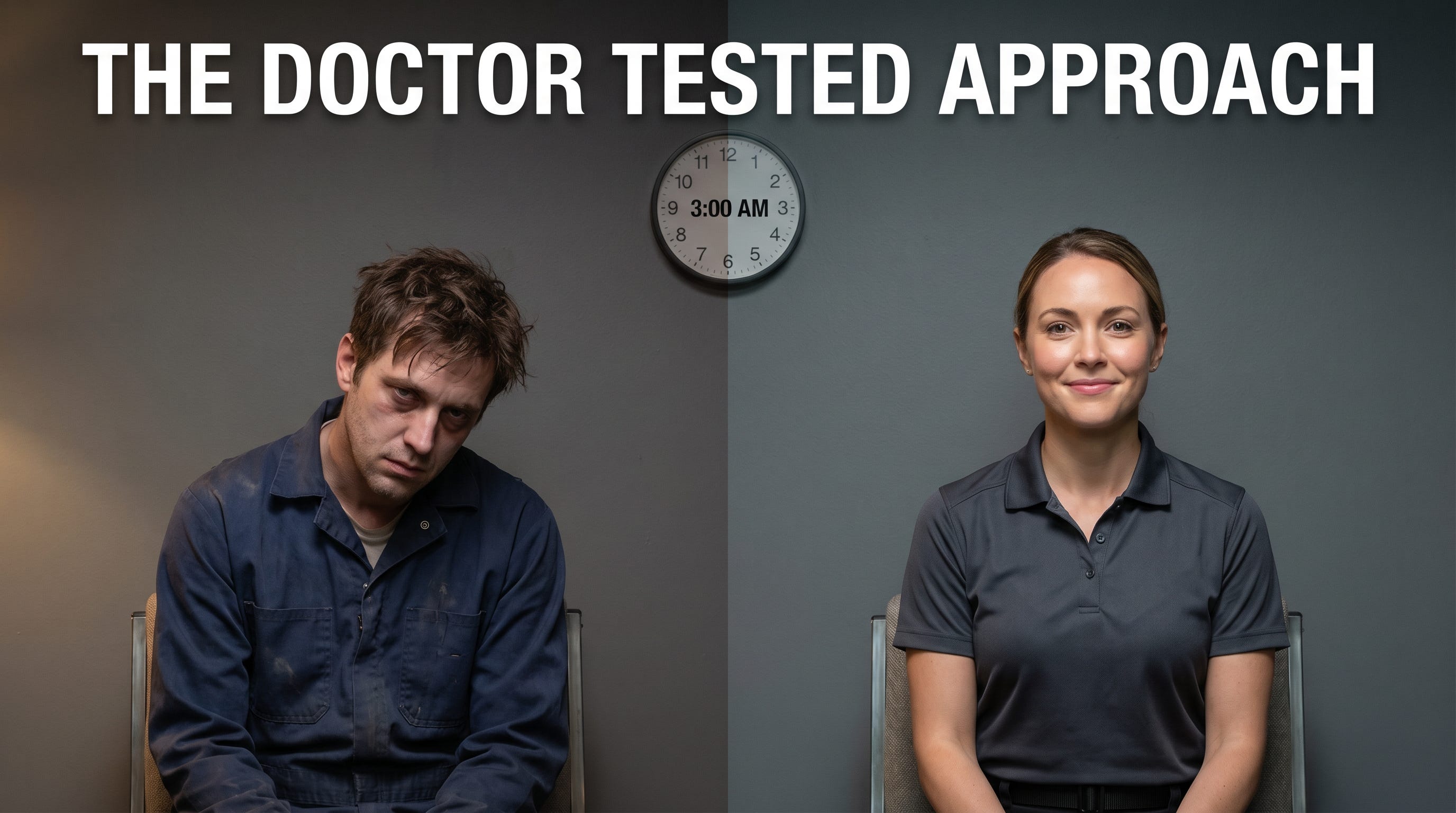
First, a disclaimer:
I don’t think shift-work is healthy. No matter how good your strategy is, it’s an effort to mitigate the chronic insult on your metabolism that comes with chronic or recurring circadian disruption, and exposure to modern artificial lighting.
In fact, if you can avoid it…don’t do shift-work.
But, people have different goals and priorities. Like I do. I’ll explain.
Background
Over 2 years ago, I made a bet on myself. That I would give myself 5 years to become independent of employment from the mainstream medical industry. Independent means continue to pay off my student loans, support my growing family (3 kids) as well as my extended family, and provide the type of life for them that I didn’t have.
A big ask.
A part of that bet meant taking a job that I find both fulfilling and provides me with ample time off to spend with my family. Our kids are all under 5 years old, and for now while they want me involved in all aspects of their life…I’ll take it!

As anyone who works in the Emergency Room knows, that involves shift-work.
Although I do not condone shift-work…the reality is some of us make these decisions for personal reasons.
Which means that those of us who make such questionable decisions need some help mitigating the damages.
That’s why I decided to share my person strategy that I’ve been calibrating for over 2.5 years.
The Dangers of Shift-Work
To the average person, the impact of shift-work may seem as ‘banal’ as jet-lag. The problem with these terms is that it makes it seem like it’s just fatigue setting in. But there’s more to it than that.
First and foremost, there is the circadian disruption. Which in itself should be a major consideration. Traveling or a long night out are isolated instances of circadian disruption. But shift-work is recurring and chronic circadian disruption. The negative effects compound.
Shift work is classified as a "Group 2A probable carcinogen" by the International Agency for Research on Cancer (IARC)
Circadian disruption suppresses melatonin secretion, dysregulates the CLOCK and BMAL1 genes, reduces natural killer (NK) cell activity, and impairs DNA repair — all of which promote tumour initiation and progression
Shift workers face a significantly elevated risk of coronary artery disease, hypertension, stroke, and atherosclerosis
Circadian disruption is a well-established independent risk factor for type 2 diabetes and obesity
Circadian misalignment and decreased amplitude of circadian rhythms have been shown to predict the development of Alzheimer's disease and Parkinson's disease
Disrupted circadian rhythms are strongly associated with major depression, bipolar disorder, PTSD, generalised anxiety disorder, and schizophrenia
A major contributor to the damages of circadian disruption is the ubiquity of modern artificial lighting. Specifically, LED and fluorescent bulbs which can be harmful even during the day, simply by virtue of their physiologic consequences. Their negative effects are magnified in the setting of circadian disruption.
Together, the physiologic consequences of just these two factors are enough to make anyone’s head spin and really reconsider the decision to take on shift-work.
In my own personal experience, I’ve noticed the encroachment of some low-grade problems that could have easily gotten out of hand had I not corrected course. These include:
Morning crash (which I’ll explain why it is counter-productive from the perspective of my protocol)
Irritability
Weight gain
Poor sleep
Sweating and faster heart rate at night (in part due to adrenaline, adenosine cycling, and stress hormones)
Feeling cold and low energy (Thyroid dysfunction)
To me, these are not just standard or acceptable effects of shift-work. These are indicators that I’m doing something wrong, and need to course-correct.
But in the last few months, if my protocol is executed as intended:
No morning crash
No irritability
I’ve been losing weight and waist has shrunk
I sleep much better and feel rested before my shifts
Haven’t had any sweating or racing heart during my shifts
Sometimes, I don’t even drink caffeinated beverages throughout the shift.
This very article is being written about 14 hours after I woke up for my last shift! With less caffeine in my body than what I would drink during a normal day.
Without a doubt one of the hardest things about doing night-shift work is transitioning from day to night, and then going back from night to day. I figured out the latter pretty quickly, but the former took me some more experimentation to figure out.
My Night Shift Protocol
Alright, without further ado…let’s get into the details.
I’m going to organize this chronologically, starting from the day before my night shifts begin, and ending with the morning after my last night-shift.
