



For those of you who have been with me since the beginning will recall that this publication started as a way to research and write about my findings during the covid hysteria.
For the newer readers, I haven’t written much about covid or viruses in years. The reasons are pretty straightforward.
I don’t find covid relevant to helping people understand their body and health
Virology is like a religion…maybe a cult is more appropriate
Helping people cultivate a vibrant foundation of health is my goal
However, there is a debate that continues to this day…with opposing sides arguing over one another.
This debate is what I call the “No Virus” debate.
On one side of the argument there are people arguing that no viruses have ever been properly isolated, and therefore viruses as obligate parasitic infectious organisms do not exist…at least empirically.
On the other side, you have people straw-manning this argument and accusing the side of being crazy to suggest “viruses don’t exist.” This side tends to believe that “of course, viruses exist. What are you, crazy?”
As you may have intuited, these people are not arguing about the same thing.
In reality, they are both right.
It is true that the process by which viruses are “isolated” is full of holes, and does not hold up to scrutiny. However, this does not mean that viruses do not exist.
For example, there is no Hepatitis C virus out there, somewhere, waiting to infect you. "Hepatitis C” is the label we give a genetic transcription profile most commonly observed in people with chronic alcohol and drug abuse.
But, it came from within.
Can you “isolate” a computer virus? A psychologic virus?
All of these are simply packets of information, parceled and transmitted by different means via different mediums.
Does it mean these things do not exist? Of course not.
Many many months ago, I brought up this nuance and distinction to someone I respect greatly for his humility and courage, Dr. Mike Yeadon.
As I expected, he understood the distinction and agreed it is real. However, as he described it, that is not the battle he is in. He is debunking Virology, as an academic enterprise. Which is a totally valid perspective and argument.
I’m just not interested in that game, any longer.
I want to know how we can use this information to steward our minds and bodies through life in a healthy manner.
I’ll give you the punchline right now: viruses (and virality) exist, because genetic instructions exist.
But, are viruses parasitic or infectious organisms? No.
The real question is, WHAT ARE VIRUSES?
Let’s unpack the following:
Basics of cellular information storage and transmission
What is the definition of a Virus?
How are the #1 and #2 related?
The case of a simplest known ‘virus’
Clinical significance of viruses
Cellular Information
To understand viruses, we first have to understand how biologic information is stored, expressed and transported.
This is where knowledge of the “central dogma” of molecular biology is important.
You can think of DNA as a long-term biologic information storage system. DNA stores two types of information.
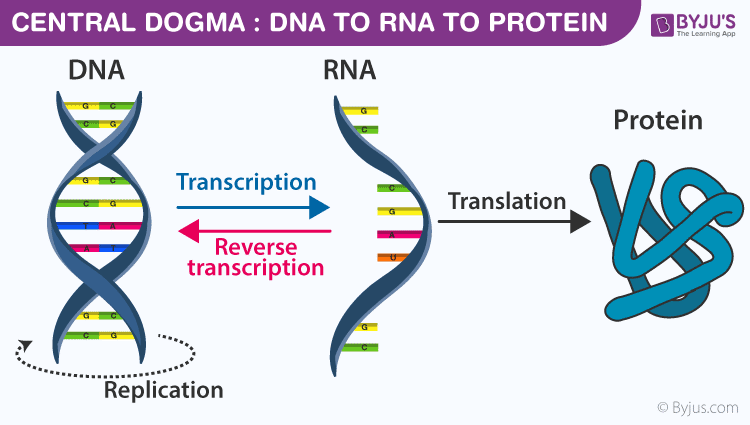
The code needed to produce proteins.
The code needed to produce various forms of RNA, which in and of themselves can have molecular consequences, without needing to be translated into proteins.
However, the environment of the nucleus, cytoplasm and extra-cellular space is so chaotic and volatile that simple nucleic acid strings (DNA and RNA) cannot exist without some sort of vehicle, or protection.
Thus, cellular life needs a mechanism that protects and accompanies RNA strands until they meet their end-use (either translation into proteins, or interaction with its final target).
Below, we see one such mechanism by which this occurs. In this image, we can see little bubbles (vesicles) which shuttle biologic matter (including RNA) from the Nucleus to other organelles, and out into the extra-cellular space.
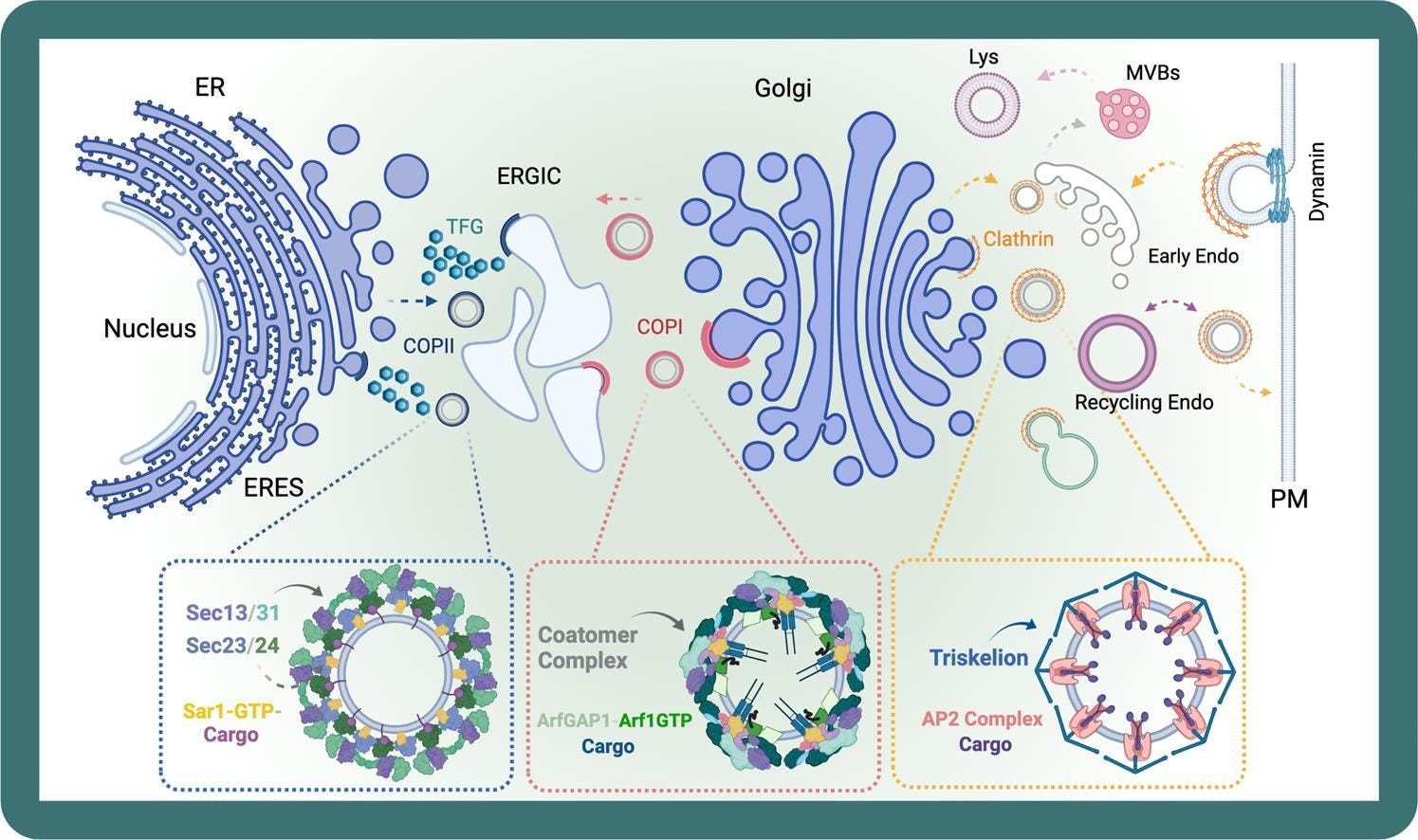
Notice the shape and structure of these vesicles. Do they remind you of anything? Below is a diagram of a virus. This virus has a genetic code at the core (RNA or DNA) and is surrounded by some combination of lipid/protein capsules/envelopes. The nature of the “capsomer” and envelope vary from virus to virus. Some have one layer of protection. Some have two. And all manner of combinations.

This is a critical point to understand. But, before we dig a little deeper into this relationship, let’s clear up a few things.
First of all, viruses are not organisms.
An organism is any living thing that functions as an individual.
…an organism has autonomous reproduction, growth, and metabolism.
Viruses do not autonomously reproduce, grow, and do not have a metabolism. Therefore, viruses are not organisms.
If they are not organisms, then the rest of the commonly used words when discussing viruses are mostly null and void. For instance, viruses are not parasites. Parasites are living organisms.
A virus has two fundamental components:
Genetic code.
A transport vehicle.
That is it.
The discovery of the simplest virus (Narnaviridae) is very helpful for our discussion. For our purpose, we will stick with one genera of narnavirus found in Saccharomyces cerevisiae.
S. Cerevisiae (SCN23 or 20S) is the simplest RNA virus and it only encodes and RNA-dependent RNA polymerase. This is an enzyme which uses a string of RNA code to generate another string of RNA code. Essentially, a process by which an RNA code can be duplicated.
They encode no protein capsid, and no virus particles other than lipid vesicles are known to be associated with infection.
The authors of this chapter, however, rather liberally use the word ‘infection’ in the above description. Because, when you or I think of infection, we think of something from the outside contaminating the cell.
However, this is not how S. cerevisiae was discovered.
The two original members of the genus Narnavirus were identified in the yeast Saccharomyces cerevisiae as aberrantly segregating cytoplasmic elements that were found in a large proportion of commercial yeast strains and were induced under conditions of high stress.
Pay really close attention to what is being said here. Commercial yeast strains were exposed to conditions of high stress. These yeast cells subsequently demonstrated aggregates of “cytoplasmic elements.”
Meaning, when yeast are placed in high stress conditions, they began expressing certain strings of genetic code (RNA). These “cytoplasmic elements” were then identified as 20S and 23S RNA strands, and used to give the “virus” it’s correspond names: SCNV23S or SCNV20S, i.e. S. Cerevisiae Narnavirus 23S.
Do you see the sleight-of-hand here?
The experiments induce the yeast to produce unnatural quantities of a string of genetic code, because of unnatural conditions…and then called the result of this…a virus.
They aren’t wrong, technically. But, this depends on the framework.
If your framework is that “viruses are pathologic parasitic infectious agents,” then this is stupid.
But, if you use the framework that viruses are simply packets of genetic instructions…then, it works. Because, that is what they are.
This case of the simplest RNA virus is, in my opinion, a canonical demonstration of a) what viruses are, and b) how they are discovered and labeled.
I guess what I’m trying to get across here is just how banal it is that something is called a virus. You may as well just call them genes, or gene fragments.
But, we don’t. Because often times a viral particle contains more than one gene or fragments.
Once you realize that this is what viruses truly are, it becomes much easier to understand how biologic viruses are very similar to viruses of other mediums (e.g. computer or “mind” viruses).
Furthermore, you also start to realize how futile efforts to vaccinate against viruses are. Because…well…how do you vaccinate against information?
Why do you think people who receive polio vaccines develop paralysis?
Or, those who receive a flu shot get the flu?
Or, those who get shingles from the shingles vaccine?
Because the vaccines contain the instructions!
This is why viral vaccines have proven to be such astounding failures, decade after decade, and billions after billions spent on their development.
Clinical Relevance
Circling back to why all this matters.
How does this knowledge and understanding of viruses help us make informed decisions about our health? When should we be concerned about viruses?
To a large extent, viruses matter because they activate exaggerated or novel response mechanisms. All life has co-existed with viruses since the beginning of time. This is why a large proportion of our DNA are viral gene fragments.
So, what are we to do about viruses?
We must have a robust health, for several reasons.
It’s good to be in good health, duh.
When we encounter a novel virus, our bodies know how to process this new information without overloading ourselves.
We feel confident in exploring and encountering new conditions in our environment, so that we can continue to update our repository of viral information.
Thus, the solution is not to live in a bubble, sterilize every surface, and receive every injection manufactured by Big Pharma. This is a surefire way to get sick.
The solution is building a robust foundation of health.
Foundational Health is where it all starts.
As a final remark, I’m sure some of you are scrambling to let me know that viruses cause cancer.
No, viruses don’t cause cancer.
Just like the yeast that were under high stress…and started focusing on pumping out 1 gene over and over (in oncology terms this is analogous to a monoclonal expansion)…it’s the environment.
If your environment is stressing you to the point that your genetic machinery is singularly focused on making one thing, and replicating/replenishing in one direction. You develop cancer.
But, the response to the stress is not the proximate cause of the cancer.
Thank you for saying the quiet part out loud. I too have discussed the distraction of the "virology" and "no virus" camps with Dr Mike, and he has more patience and perhaps a nobler fight than mine. Both camps are wrong, and both camps are right....from a certain point of view.😉
At a clinical level, what helps my patients more? Is me explaining the nuance of both views in a way yhat they can accept and use to take control of their health, instead of being passive victims of both the allooathic and/or alternative models of medicine. One cannot heal without cleaning the fish bowl, but one also cannot afford to buy health in a bottle forever, in liu of addressing the root cause, or light.😉
Thank you for taking this one on! I will read your article thoroughly, but I have believed it is another distraction campaign away from the truth (little t) for a long time. I am a veterinarian and have witnessed viral epidemics sweep through kennels of dogs and cats, litters of puppies and kittens. so yes, something is being transmitted killing these animals. we can isolate the area, disinfect and stop the spread. i have seen it with my own eyes.