


Given that the peptide market is in the “hysteria” phase of its trajectory, I thought it would be appropriate to conduct a sober investigation. So, I did.
And, I decided to start it with one of the most widely discussed peptides: BPC-157. You are about to see just how fundamental an investigation I am talking about. Because as it turns out, the hype around BPC-157 doesn’t even pass the most basic questions.
Since the rise of GLP-1 (e.g. Ozempic), I’ve encountered more questions about peptides broadly. To be transparent with you, my bias and instinct is to be skeptical of all them all. Take that however you want, but I’ve been around the block enough times to know that things are rarely as they seem. It was this instinct which led me to thoroughly investigate and analyze the covid injections. And…I’d be a fool to think that the hysteria over peptides is any different.
the story we are fed
If you tune into any podcast, a wellness social media channel, or any vendor website…you will see some variation of this sentence:
BPC-157 is a 15-amino acid fragment of a naturally occurring protein found in human gastric juice.
You may not know it, but the marketing has already begun.
Because the two claims naturally occurring “protein” and “found in human gastric juice” have never been confirmed. When I discovered this, I decided to go full Michael Burry on this peptide.

This may shock you. Because it shocked me. Not because some pharmaceutical vendor or conflicted lab made the claim. No.
I was shocked because voices in the health community whom I respect and trust have parroted this same line. Maybe they did it unknowingly, but that’s precisely the point. They bought into the hype without doing their due diligence.
During the process of this investigation, I had an epiphany that I’m still working through:
That the original protein BPC (which was never confirmed), may have been masking the effects of another molecule which we know exists and have been using for decades.
Which means there is a better understood, proven, safer, and effective alternative to BPC-157.
Here is how this article breaks down:
How BPC was discovered: Is BPC a naturally occurring human protein?
What BPC-157 is and is not, and what it does therapeutically.
What the patents reveal.
What else behaves exactly like BPC-157?
What this tells us about the peptide market broadly.
the idea that came first
In 1975, a second year Croatian medical student named Predrag Sikirić had an idea: if stress can damage the stomach, then surely the stomach must make a compound that protects itself.
He gave this hypothetical compound a name, Substancija Bože Pomozi - God Help Me Substance.
In 1981 his team began collecting gastric juice from clinics, hospitals and emergency rooms locally and as far as Bosnia. But it wasn’t just humans, they also collected the juice from animals including pigs from slaughterhouses.
“Finally we isolated the expected substance from the stomach juice of 542 patients.”
“The agent BPC was prepared from human or animal gastric juice.”
“The agent BPC according to the invention was investigated in vitro and in vivo (rat, mouse, rabbit, and guinea-pig).”
They go on to list a number of disease-inducing experiments conducted on these animals with BPC used as the therapy. We will go into all the specific diseases a little later.
But, this is really important to keep in mind: they did NOT inject these animals with BPC-157. Their patent clearly states they gave the animals BPC - i.e. whatever substance they extracted from the stomach.
the elusive protein
Now, the really important question is did they really isolate one protein?
Because here is what they did with that pooled gastric juice:
They homogenized and centrifuged the solution.
200 mL of whatever was left on top was extracted and processed through various fancy sounding terms. (details can be found in the patent)
Then they’d dried out and obtained a very minute amount of substance, which was then distilled in 10 mL of water.
Then this solution was placed in a gel chromatography column.
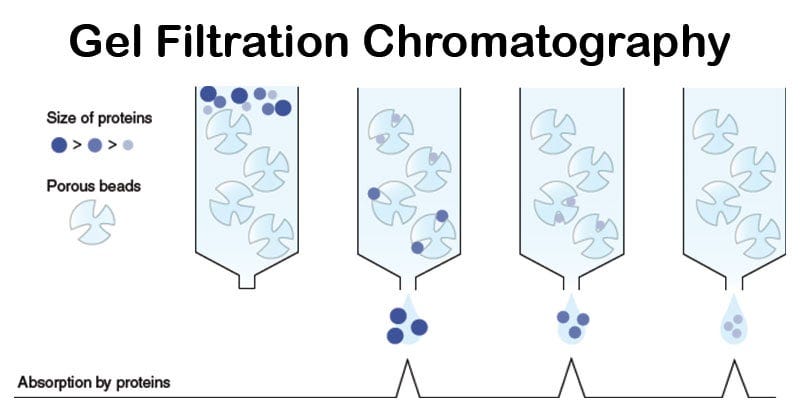
Based on what came out the other end, they claim that BPC is a single protein about 40 kDa in size. Here is the problem with that statement:
The process they use allows them to approximate the size of the substance that passes through the column
molecular weight is inferred - not measured.
And, most importantly: it does not confirm that it is one single protein.
Right after describing this process, they immediately claim that they only sequenced 15 amino acids out of the whole protein. A 40 kDa protein has up to 400 amino acids. But they simply claim a 15 amino acid sequence, followed by an ellipsis (…)
Again, this is all in patent filings. Not published research.
Anna Mapp (chair of the American Peptide Society) reviewed the patents and stated quite clearly:
“There was no demonstration that I could tell that it was a single pure isolated substance…”
What’s more, in a subsequent patent that the group filed in 1993, they make the following admission after describing the wide therapeutic benefit of this so called BPC:
“…this broad spectrum of activity can be probably a consequence of undetermined structure or even of insufficient purity or homogeneity of isolated compound BPC.”
Do you understand? The people who harvested BPC and designed the synthetic sequence BPC-157, admitted from day 1 (and to this day)…that it’s possible they never isolated a single protein.
To this day, there is still no full protein sequence, no gene, no discrete mechanism or receptor interaction that has been identified.
Just to recap, we have so far established the following:
Sikirić was looking for a compound that responds to stress and can survive the hostile conditions of the stomach
They isolated something from pooled gastric juice from humans and animals
All the tests on disease models were conducted using BPC (NOT BPC-157)
They admit in their own patent, the variety of therapeutic effects could be because the compound was not pure.
That is to say, there could be other things in the isolate other than one protein (ie. BPC).
what about BPC-157?
Now, according to their patents they only sequenced a 15-amino acid chain on one of the protein…and just…stopped there. Or, at least they never reported anything other than this 15-amino acid chain.
For starters, this means that no other lab can check the validity of their claims.
The claim that:
BPC is a single protein
This single protein exists in humans
and is made in the stomach
All of the above were merely asserted in patents.
It’s important to note that both in the European and US Patent, they make the following assertion about BPC-157:
Surprisingly, it has been found that this fragment retained practically all effects of the natural BPC protein (EP 0572688 and U.S. Pat. No. 6,268,346).
The N-terminal part with a sequence of 15 amino acids seems to be the most responsible for the biological activity of the entire protein.
And, of course their evidence for these claims are their own patents.
Which brings up another question:
Why did they only study and produce to this 15-amino acid chain?
Even Sikirić et al admit that the original protein is actually quite hard for them to isolate, and they were worried about virus contamination.
At this point it’s important to understand that the BPC-157 is not naturally derived. It is a sequence with no confirmed origin (other than the patent claim). Which means that BPC-157:
it is an artificial sequence
produced by synthetic means
using modified (unnatural) amino acids and other such processes
The vast majority of the published research on BPC-157 (last I check around 80%) was produced by the lab of Sikirić and collaborators.
Now, in full transparency it should be mentioned that a few unrelated research groups have demonstrated some findings. For example, Chang et al found that BPC-157 increases growth hormone receptor expression in tendon cells of lab rats tested in vitro.
As a quick summary, this is what has been tested on humans and published:
Lee & Padget (2021) compared knee injections of BPC-157 alone against BPC-157 and Thymosin Beta-4.
12 received BPC-157 only and 11 of those people reported improvement in knee pain.
4 received a combination of BPC-157 and TB4, and 3 reported improvement.
Ayadi et al (2024) tested BPC-157 in women suffering from chronic bladder inflammation. 12 women total had BPC-157 instilled directly into their bladder.
10 women reported complete relief of symptoms
2 women reported relief of most symptoms
Lee & Burgess (2025) tested to see if it is safe to inject BPC-157 directly into the veins. Tested in 2 (TWO) people.
On day 3 after injection, they report no lab markers to suggest side-effects.
The take-home summary is this:
After 31 years of research, 544 published papers, all we have to show for it are 2 small case-series without any control arm or placebo test.
what is still uncertain
First, it is still unconfirmed that BPC-157 is a naturally occurring fragment of a single protein.
So this claim you see on marketing, podcasts, and everywhere else is total BS. But, most of the parties involved don’t seem to care, because as long as there are benefits without side-effects - who cares?
So, let’s talk about the benefits.
Currently, there is still no receptor interaction that has been identified for BPC-157. Proponents will claim that this peptide can interact by some other means. Which is completely plausible…that is until you look at the dosages used.
As far as we can tell from their patents, the inventors used doses of BPC-157 as low as 10 nanograms per kilogram (of animal weight) and as high as 10 micrograms per kilogram. That is a 1000-fold difference in dosage.
Very importantly, they never tested anything lower - so they have no clue what is the minimum necessary dose to achieve an effect.
But, despite the vast difference in dosing…they observed the same effects…with no adverse effects or toxicity.
In a 250 gram rat, the lowest dose used is about 2.5 nanograms - which puts us in the picomole concentration for effects. For reference, 12 picomoles/L is an expected concentration for a potent signaling molecule. For example, Free T3 (active thyroid hormone) circulates at around 5 picomoles/L. Similar magnitude for oxytocin and estradiol.
But there’s an important distinction here. Thyroid hormone, oxytocin and estradiol have effects at this low dose because they have receptors which amplify their effects. Without this amplification mechanism (and short half-life ~30 minutes), it’s hard to make sense of this mysterious peptide (BPC-157).
If you never run a dose low enough to get no effect, how can you know that it’s the peptide that’s causing the effect? If the effect and risk-profile is the same no matter how much you tested…this adds another layer of confusion.
So the question to ponder is…if BPC-157 has all of these amazing effects, and at such a low dose…how does it do this?!
what Sikirić didn’t know to look for
When I was listening to a recent episode of Andrew Huberman’s podcast, he and his guest Abud Bakri were discussing all of the alleged benefits of BPC-157. In reality, they were discussing the benefits published by the same authors who synthesized BPC-157. Very few of these effects have been replicated by anyone else.
The inventors merely claimed that the effects of BPC-157 are the same as purified gastric juice. They never published any tests comparing BPC to BPC-157.
In any case, Huberman and Bakri were discussing everything from gastric problems to tendon and ligament injury, to neurological problems. They even described a case of rats being less drunk when given BPC, and mitigating the effects of alcohol.
While doing my research for The Peptide Dossier, I realized something strange…
BPC-157 does not just have benefits throughout the body, but also in opposite directions. BPC-157 counteracts L-NAME, but also L-Arginine (two drugs). It prevents clotting…but also prevents bleeding. It lowers high blood pressure, and raises low blood pressure. It grows blood vessels for healing…but not for tumors.
A miracle drug.
It’s not like these sorts of substances don’t exist…but the fact that there is no confirmed mechanism to account for this behavior is strange.
As I was listening to them discuss this…it dawned on me all at once.
It occurred to me that there is one other molecule which has all of the claimed features of BPC-157, including:
made in the stomach in response to stress/inflammation
resistant to degradation by stomach acid
has a whole variety of beneficial effects from the gut, to joints, to brain, to liver…
…and yes, even mitigating the effects of alcohol
And, as far as we know it truly is a miracle compound.
The only difference is we’ve characterized it, know its structure, and its interactions.
Melatonin and the great masquerade
Around the same time that Sikirić was dreaming of a stress-responsive compound released by the stomach, a research group in Moscow identified something very interesting.
Whereas in the past it was thought that melatonin is only made and released by the pineal gland, Raikhlin & Kvetnoy discovered that cells of the gut (enterochromaffin) make melatonin (1975).
Here is a shortened summary chart of all of the claimed benefits of BPC-157 compared to the observe/known benefits of melatonin. The real list is longer than this, but the overlap is nearly complete.
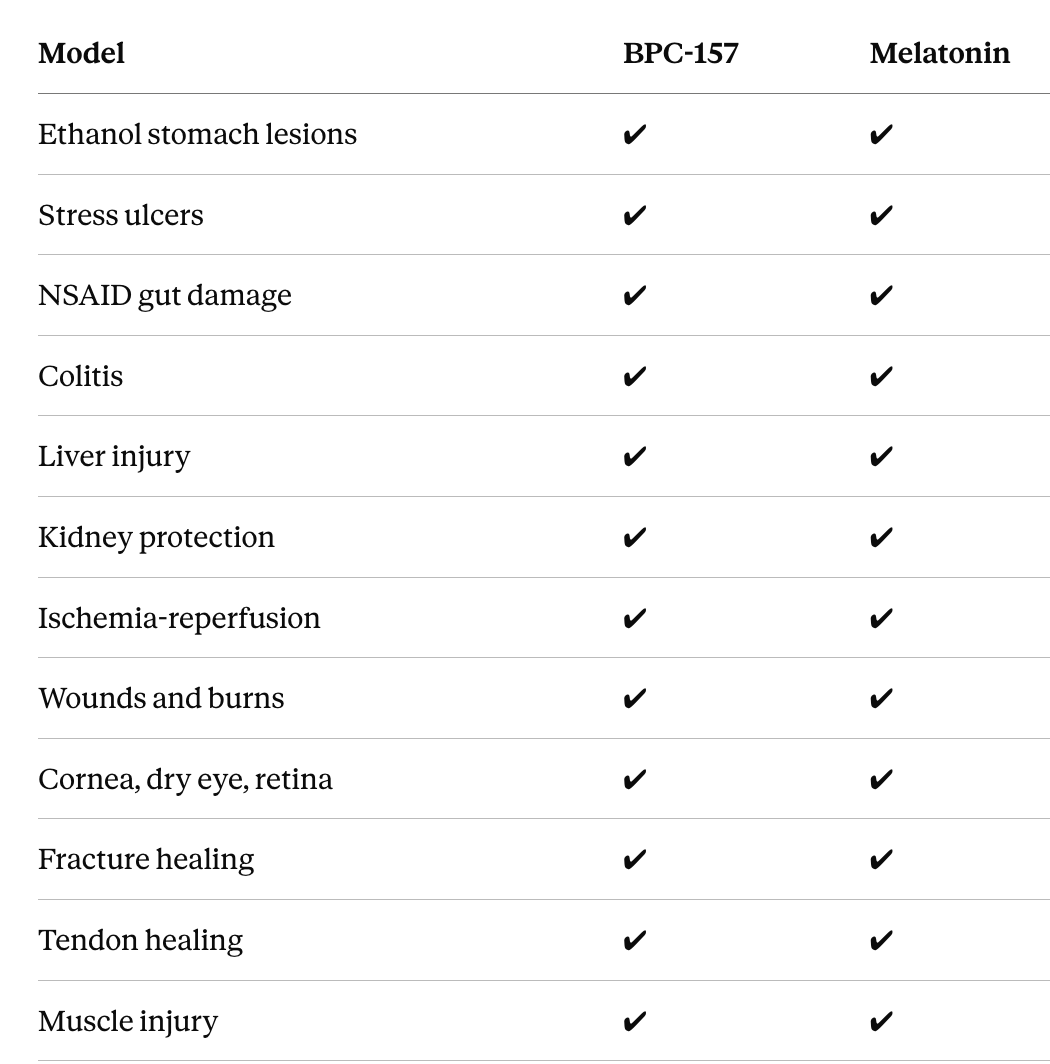
At the same time that Sikirić was claiming all the benefits of BPC-157, his contemporaries had demonstrated the same benefits in known melatonin…including the effects on alcohol consumption.
Once I confirmed this overlap, my next question is…why did the Sikirić group observe the benefits they did from purified gastric juice? How come BPC had the same therapeutic profile as melatonin?
Turns out the answer to this lies in the only thing they sequenced: BPC-157.
Let’s take a look at this 15-mer sequence:
Glycine-Glutamic Acid-Proline-Proline-Proline-Glycine-Lysine-Proline-Alanine-Aspartic Acid-Aspartic Acid-Alanine-Glycine-Leucine-Valine
It’s especially interesting to note what Sikirić’s parent company (Diagen) states about this sequence
A protein BLAST search of this sequence performed against the human data base only matched some similar results, but far away from 100 % identity.
The characteristically motif -PPPGKP- present in high frequency and periodically has been found in saliva by many investigators.
What is interesting about this proline-rich motif?
Proline-rich proteins bind small aromatic molecules, using the proline-amino acid chain. The first proline in that proline-rich chain is the preferred binding spot. When researchers compared the aromatic compounds, it seems that this proline motif has the greatest affinity for indole aromatics.
As it turns out, melatonin is an indole aromatic.
Which raises a possibility that nobody has tested.
The gastric juice Sikirić et al purified and isolated was a mixture of proline-rich proteins bound to melatonin. Which is why the vast majority of their tested effects were observed with BPC (the gastric juice isolate).
My assertion here, is that depending on where BPC-157 is administered…it can bind and stabilize melatonin - which has a very short half-life when unbound.
The effect this would have is to prolong the period of time over which melatonin can have its wide and known beneficial effects.
But, the benefit would be observed in places where melatonin production is abundant - for example, in the upper gastrointestinal tract (like the stomach - which produces 400x more compared to the pineal gland).
Now, I can’t prove that this is the case, but let’s just review what we know for certain and you decide what the most likely explanation is.
Sikirić et al identified a gastric juice isolate that:
is produced by the gut
stable under acidic conditions
has diverse effects across the entire body
incredibly potent anti-oxidant
mitigates harms of many substances including alcohol
has never been isolated since
protein sequence, gene, and interactions still unknown
has a proline-rich motif that binds melatonin
All the while, melatonin does everything BPC has in its favor and more.
what this tells us about the peptide market broadly
I didn’t start with BPC-157 because it’s unusual. I started with it because it’s representative.
Go back to that opening sentence: a 15-amino acid fragment of a naturally occurring protein found in human gastric juice.
That sentence isn’t describing a molecule. It’s moving a compound out of the drug aisle and into the supplement aisle.
“Naturally occurring” does that heavy lifting.
“Peptide” does the rest.
What I discovered about BPC-157 when asking such basic questions led me to realize that I need to ask more penetrating questions about the whole market.
Which led to the production of The Peptide Dossier.
The Peptide Dossier
The above is the result of an investigation that was carried out in an effort to inform people of the validity, safety, and benefits of BPC-157.
What started as an investigation into 1 peptide, quickly turned into my own personal research project about several other peptides.
The Peptide Dossier is a live and quarterly updated research summary that I created to share with people who are interested in this space.
The guiding principle for this research summary is very simple, but telling:
Would I give this substance to my loved ones?
Currently, The Dossier is available as a complementary Perk to paid subscribers.
If you would like to purchase The Dossier without having to become a paid subscriber, let me know in the comments below or shoot me an e-mail at peptidedossier@pm.me
Remnant.
Blasted through the dossier.
Blows my mind how 90% of benefits of peps can be achieved from improving sleep and sunlight 💀
Remaining question though.
Why is supplemental melatonin associated with negative warnings around safety and long term use? Would there be a mechanism of bad action you can think of?
Thank you for this informative article. I've not found any other info to date that raises plausible arguments that counter the deluge of pro peptide hype.