



UPDATE:
As our paid-supporters know, we have published our first episode of the Foundational Health podcast. Now, it is also available in audio form on podcast platforms like Spotify.
On the morning of March 21st, the full video will be available for everyone to watch on our Youtube Channel.
Background
Ever since encountering the work of Jack Kruse, I’ve been enamored by the relationship between light and life. It’s not simply the contrarian in me gravitating towards another perspective which runs counter to medical dogma.
No.
There’s something about the Sun that I’ve always had a positive relationship with. That is until I started listening to the mainstream and avoiding it.
When I was young, I would be outdoors as much as possible. Under the Sun, playing any and all sports…until it set. Never encountered a problem. That is until our family fell victim to mainstream dogma.
Like most families in the developed West, we started using sunscreen. As I got older, it became “cool” to wear sunglasses. That’s when things took an unpleasant turn.
I started getting sunburns. My eyes were more sensitive to sunlight.

But, ever since I encountered Jack Kruse’ work…my relationship with the Sun was renewed. I realized it isn’t something to fear. If anything, to embrace. Ever since this renewal, I have been sunscreen and sunglass free for over 4 years. No sunburns.
Deeper Than Skin
As I dug deeper into Kruse’ work, I learned that the Sun plays a much larger role than simply regulating sleep and tanning our skin.
As Kruse likes to state, light is more important than diet.
Many, including myself, not only found this hard to believe…but, I suspect do not fully grasp what he is trying to say.
Recently, I picked up a copy of Roeland Van Wijk’s latest book:
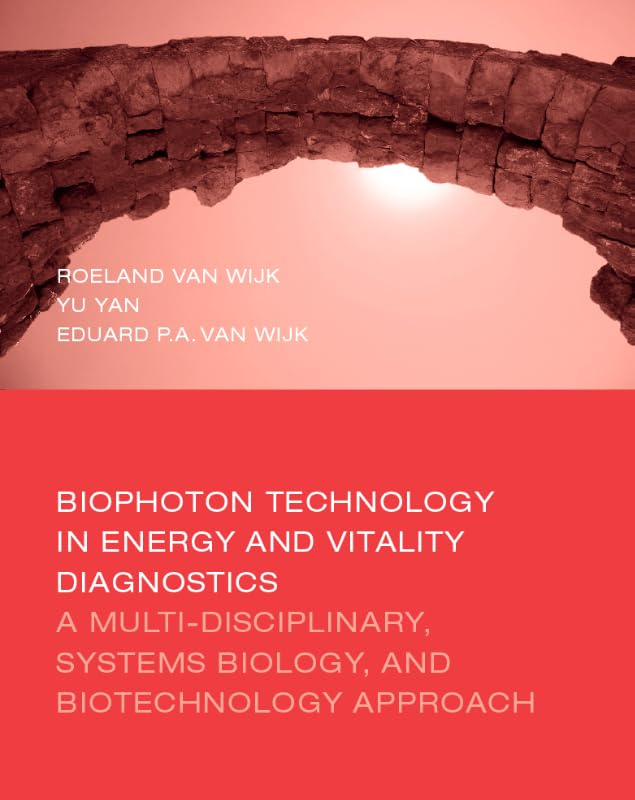
In this book, Van Wijk reviews some of the earlier work on the role of photons (more accurately than light) in effecting and regulating metabolic functions. After digging into the basics of the biophysics, I think I have a decent grasp of what Kruse is trying to convey.
That’s what I want to share with you.
From the Basics
I’m talking really basic.
‘What is life?’ basic.
Life is the process by which energy is harvested and transformed to create order from the chaotic potential of the world around us. This is true of plants, single-celled organisms, and humans.
Further, living beings have the ability to harvest and transform energy at will. Not necessarily by conscious will, but by physiologic need.
This is a really important point to consider, because according to the Law of Conservation of Energy…energy cannot be created nor destroyed.
It can only be transformed.
When we talk about health in the modern era, we often talk about things like
Metabolic syndrome
Oxidative stress
Insulin resistance
Essentially, chronic illnesses which are a manifestation of inefficient/ineffective energy flow and transformation.
So the question is…where does all terrestrial energy ultimately come from?
Turns out, this is a bit of complicated question.
On the one hand, all mammalian life ultimately comes from the consumption of plants. Whether you consider the cow grazing on the field, or the wolf eating that cow.
On the other hand, we need to consider all of the metabolic processes that occur in the plant, the cow, as well as the wolf.
For the plant, our dogma already has the answer baked in. Plants undergo photo-synthesis, to make the “foods” (aka energy stores) they need to live and grow.
But, what about the cow and wolf?
What is Food?
Foods, at minimum, have a dual purpose.
Foods are a store of energy - think sugars, fats (and even proteins).
Foods provide the building blocks of our tissue - lipids/fats, proteins, and amino acids.
It’s not just food that has stored energy. Our own body has stored energy, in the form of complex macromolecules.
So foods are a store of energy, right? Problem solved.
Not so fast.
I give you an orange, packed with energy. Can you just spontaneously assimilate this into your body and use its energy stores?
No. It needs to be transformed. This requires energy.
However, using that explanation to explain the primacy of photonic energy would not only be “cheating,” but it would be incorrect.
Every metabolic reaction requires an interaction between substrates (ingredients) to make something new (product)…with a shift in energy. Either energy is put into this reaction, or energy comes out of this reaction. Often, both happens…with a net shift of energy from one side of the reaction to the other.
Biochemical reactions depend on the ability of electrons to be exchanged between molecules, or used in the creation or destruction of bonds between the ingredients and products.
This is where we enter some basic quantum physiology.
If all life is the ability to harvest and transform energy…then, we must necessarily focus on the fate of energy flow…or electron flow. Because, it is the movement of these electrons which allow for chemical bonds to be formed and destroyed.
Everything from vision, to nerve conduction, to ATP generation by the mitochondria using the electron transport chain. It’s right there in the name. Whether you want to think of it as electron flow, energy flow, or current…it’s all really the same.
The importance is in realizing that a healthy and robust metabolism is one in which energy is transformed, used, and stored with optimal efficiency.
Once you take this perspective on life and energy…you can start to see proteins (the molecules encoded by our genome) in a new light. That proteins are semi-conductors.
Conductors allow energy (electrons) to flow freely through the material, such as a copper wire.
Semi-conductors (like Silicon) introduce an “energy gap” that needs to be bridged before the electron can move from the static (non-conductive) band to the conductive band.
Thus, semi-conductors enable the selective movement of electrons in a tissue/material. Depending on the purpose of the reaction (and protein), the energy-gap that the electron needs to cross varies.
That is to say, the excitation energy the electron needs to jump from the non-conductive state to the conductive state, is specific to the protein/enzyme involved in the biochemical reaction.
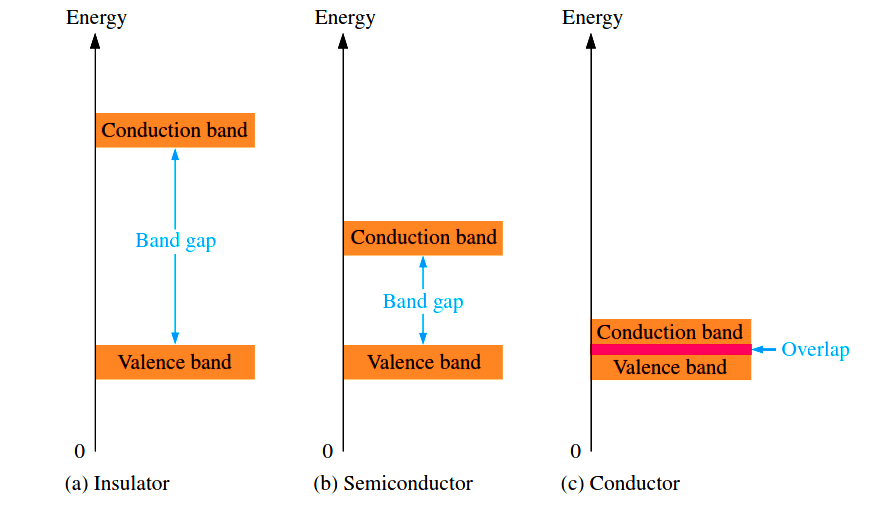
The great insight about proteins in the last couple of decades is that proteins (perfectly encapsulated in the function of enzymes) are semi-conductors.
As such, every protein has a specific band gap that needs to be bridged. This bridging occurs by the excitation of the electrons in the corresponding molecules/atoms involved in the reactions.
Thus, it isn’t enough that I give you an orange.
I need to give you electromagnetic packets of energy - AKA photons, to activate the electrons in the relevant proteins involved in the digestion, harvest, transformation, and storage of energy from that orange.
Once You See It…
Once you grasp the importance and relationship between photonics and electrophysiology, you will appreciate its role in metabolism.
Everything from receptors on your skin, under your skin…in the fat below your skin, in your retina….in your bloodstream…in your mitochondria…it is all photon-dependent.
Here is a list you can use to guide your research:
1. Flavoproteins (FAD/FMN-containing enzymes)
Example: Cryptochrome
Blue-light absorbers (~450 nm)
Central to redox metabolism (NADH/FADH₂ handling)
Light → circadian gene expression + mitochondrial signaling
2. Cytochromes (heme-based ETC proteins)
Example: Cytochrome c oxidase
Absorb red/NIR light (600–1000 nm)
Directly modulate electron transport and ATP production
Photon input can displace nitric oxide → increase respiration
3. Opsins (retinal-binding GPCRs)
Example: Melanopsin
Use vitamin A–derived retinal as chromophore
Convert photons → GPCR signaling cascades
Regulate circadian rhythm, hormones, and possibly peripheral metabolism (skin, fat)
4. Heme-containing enzymes (beyond ETC)
Example: Catalase
Heme absorbs visible light → alters redox state
Involved in ROS handling and oxidative stress
Light can shift peroxide metabolism
5. Nitric oxide–associated proteins
Example: Nitric oxide synthase
Not directly photoactivated, but light liberates NO from heme sites
Couples photons → vasodilation + mitochondrial efficiency
Acts as a bridge between light exposure and perfusion
6. DNA repair photoproteins
Example: Photolyase
Use light energy to reverse UV-induced DNA damage
More prominent in non-mammals, but conceptually key
Tie light → genomic stability → downstream metabolic integrity
7. Ion channels with photomodulation (indirect in humans)
Example: Channelrhodopsin
Direct in microbes; indirect analogs in humans
Light → ROS or chromophore effects → Ca²⁺ flux
Ca²⁺ shifts strongly influence mitochondrial activity
8. Iron–sulfur cluster proteins
Example: Aconitase
Light-sensitive via Fe–S cluster oxidation
Core to TCA cycle + electron flow
Vulnerable to photon-induced redox perturbation
It’s Not Just the Proteins…
If that weren’t enough to punctuate the importance of photons in metabolism…we haven’t even talked about the biological molecules which are not proteins.
These molecules are equally as important as the proteins, and are also photon-dependent.
Broadly speaking, these molecules cluster into:
Conjugated π-electron systems → absorb light (flavins, porphyrins, indoles)
Isomerizable bonds → structural switching (retinoids, urocanic acid)
Redox flexibility → electron transfer shifts (NADH, CoQ10, bilirubin)
Highly unsaturated chains → electron mobility (DHA)
Here is another list to whet your research appetite:
1. Retinal (retinoids)
Photon → cis–trans isomerization
Initiates neuroendocrine signaling cascades
Drives circadian entrainment, hormonal rhythms, autonomic tone
2. Melatonin (tryptophan-derived)
Light suppresses its synthesis (not direct activation, but tightly photon-coupled)
Governs sleep, mitochondrial function, antioxidant status
System-wide timing signal (“darkness hormone”)
3. Serotonin (tryptophan-derived)
Light exposure increases synthesis (retina/brain axis)
Regulates mood, gut motility, vascular tone
Precursor pool for melatonin → links day ↔ night physiology
4. Nitric oxide
Photolabile → released by UV/red light
Rapid systemic effects: vasodilation, blood flow, mitochondrial respiration
One of the fastest ways photons affect whole-body physiology
5. FAD / FMN
Blue-light responsive redox cofactors
Control electron flux through metabolism
Systemic impact via mitochondrial output + ROS signaling
6. Coenzyme Q10
Lipid-phase electron carrier
Interfaces with photon-sensitive ETC components
Influences ATP production across all tissues
7. NADH / NAD+
Central redox currency
Light shifts balance indirectly via upstream chromophores
Governs metabolic rate, repair, and signaling (e.g., sirtuins)
Is Light More Important Than Food?
Look, food is obviously an important contributor to our tissue and health.
No question.
But, which is more important?
Think about your standard combustion-engine vehicle.
You can think of gasoline and engine oil as the foods of your car.
But…how are you going to drive that car without an ignition?
I worked with uncle Jack before the heart surgery (aortic valve). This is when I started to use red/ infrared light, sunrise,cold…
From what I have read, sun also structures the water in the body, and structured water is basically what most of the water in our body is, especially the fascia. I whole heartedly agree with your premise.