



This will be the topic of conversation for our upcoming Live Q&A on September 27th.
We’ve all been there. The season changes, or the weather shifts. A sleepless night, perhaps. Unusually high burden of stress at work (or at home). In any case, we experience an impactful disruption.
Too often we get the urge to just grit our teeth through the experience, hoping we will come out in one piece at the other end.
Then, one morning, a sign. A tickle in the throat. Or a light sneeze. That’s when you know.
A cold is about to descend upon you.
And if you are anything like me, your instinct is to say:
It’s probably nothing. I’ll be fine.
I’ll just have some tea and go for a walk.
And if you are really like me, that walk involves carrying 30 pounds in your backpack for 2 hours.
In that one decision, you have missed the optimal window to facilitate the evolution and evacuation of this cold from your body.
Just over a year ago I wrote an essay about how some of my family members (and myself) caught a cold while on summer vacation.
In that essay, I described the mechanism by which we catch a cold.
Not influenza. Not a virus. A cold.

I’m happy that it was received quite well despite the unorthodox perspective. I suspect that it was because the mechanism I proposed was one people could resonate with, and saw themselves in the story. Like most medical wisdom that has survived for millenia, this account just made sense.
To drive home the point about humans being creatures of habit, I caught yet another cold at about the same time this year. As with virtually all my colds, they come on during a period of excess stress and overworking. I have a habit of not being gentle on my body, which both my wife and mother have been reminding me about.
This time around, I decided to be a bit more methodical in my recovery process. As someone who has been learning and applying the wisdom of Unani (Greek) Medicine, it seemed like the perfect opportunity.
It did not surprise me that the likes of Hippocrates, Galen and Avicenna had a systematic approach to moving a person through the stages of a cold. To focus on facilitating the healing process.
This gave me more confidence in this framework.
My goal in writing this is to make a thorough account of a “cold” and how to recover from it. Something I can use as a reference, and send to friends and family.
Questions To Answer
What is a “cold” and which organ is impacted?
What are the stages of a cold?
How do we facilitate our body in moving through these stages?
What should we avoid during this 4-step process?
Modern western medicine approaches a cold like an invasion which requires support of the body and symptomatic relief.
This is incorrect.
A cold is a state of the body in which excess/abnormal fluid is being expelled from the head.
The key which determines if this process progresses smoothly or with complication is TIMING.
When the excess/abnormal fluids of the head first emerge, they are thin and without form. Which means that they will have a tendency to simply relocate to other body parts (e.g. throat and chest).
Which makes the first two stages critical.
We are buying time for the body to mature these fluids into something the body knows and can expel.
In effect, you are racing to mature these fluids before gravity/physiology moves them elsewhere.
What is a “Cold”?
Before we dive into the description of what a cold is, it’s useful to remind ourselves of where these symptoms begin.
A headache or fullness. A sniffle or a sneeze. A tickling throat. Notice the direction of the symptoms. Top-down.
Head → Throat → Chest
This is central to understanding the evolution of a cold.
In Unani medicine, every organ has a temperament. A natural balance of heat and moisture that serves that organ best. The heart is the hottest. Bone is dry. The brain is cold and moist.
As the body digests what we consume, the fluids that are produced undergo evolution/maturation into different states, each of which is ideal for various body parts. For instance, the production of cold/moist phlegm (serous fluid) is ideal for the brain as it uses it for its own existence and function.
In fact, the fluid that bathes the brain (CSF) is probably the largest single chamber of water (99% water) in the body, holding approximately 150mL at any given time.
When new phlegm (serous humor) reaches the brain, it evolves this fluid into the final stage of digestion (which happens at the organ which is nourished), retains what is needed, and discharges what is residue.
Under normal circumstance, it does this slowly and imperceptibly through ordinary channels: the nose, palate, sinuses, lymphatics and venous drainage.
Thus, a cold is not the appearance of something that should not be there.
It is ordinary drainage becoming disordered. Too much, too fast, poorly formed, or wrongly directed.
How the Brain Becomes Disordered
The brain can be disrupted from two different paths. One is called a disturbance without matter, the other is with matter. Let me explain.
A disturbance without matter is one in which the temperament of the brain shift suddenly without compounding alterations in digestion.
Cold air on head/neck/face
Sleeping in a draft
Wet hair
Excessive heat on bare head
These changes in temperature matter most when they are sudden, or in stark contrast to preceding conditions.
Imagine you take a ice-cold glass of water and place it in a hot environment? Water droplets form.
Similarly, as the hot vaporous fluids of the blood ascend to the head with simultaneously rapid cooling, the vaporous components condense.
This change in fluid quantity is usually cleared quite rapidly and easily with counter-balancing efforts - by either the body, or the human who is experiencing them. Like hitting the sauna after a cold winter excursion.
Then, there is disruption with matter.
This is a disturbance that is associated with an accumulation of fluids, not simply a change in their quality. Most commonly, this occurs as a result of digestion. For a myriad of reasons, if the process of digestion is weak, overloaded, or produces immature/crude fluids - this can contribute to a qualitative and quantitative change in fluid balance in the body. The thinner/vaporous components of this poor digestion rise to the head, and meet the cold/moist substance…and again, condensate into excess fluid. But this time, they are the fluids of poor digestion.
I will experience this form if I consume too much red meat/dairy during the warmer months of the year. And consuming them at the onset of a cold certainly makes it worse.
The second manner in which this can occur is as a result of the brain/nervous system’s own failure. We will touch on a few things that modern science has observed in relation to this, but suffice it say any changes in the conditions of the nervous system which alter use, evolution and expulsion of fluids can cause it to become congested.
A classic scenario looks like this: a person carrying an accumulation of crude digestion material (poor digestion, heavy diet, and sedentary life) walks into a cold draft. The disturbance in the environment is the occasion, and the accumulated indigestion is the substance. The chill to the head weakens its retentive quality and the fluids begin their descent.
Once this combination occurs, the rest of what we experience as a cold becomes crystal clear. The matter/fluids in the brain which are in surplus and incompletely digested/matured, cannot be retained.
These fluids begin to discharge downward through the porous openings and channels along the skull base into the nose, sinuses, throat, and lymphatics.
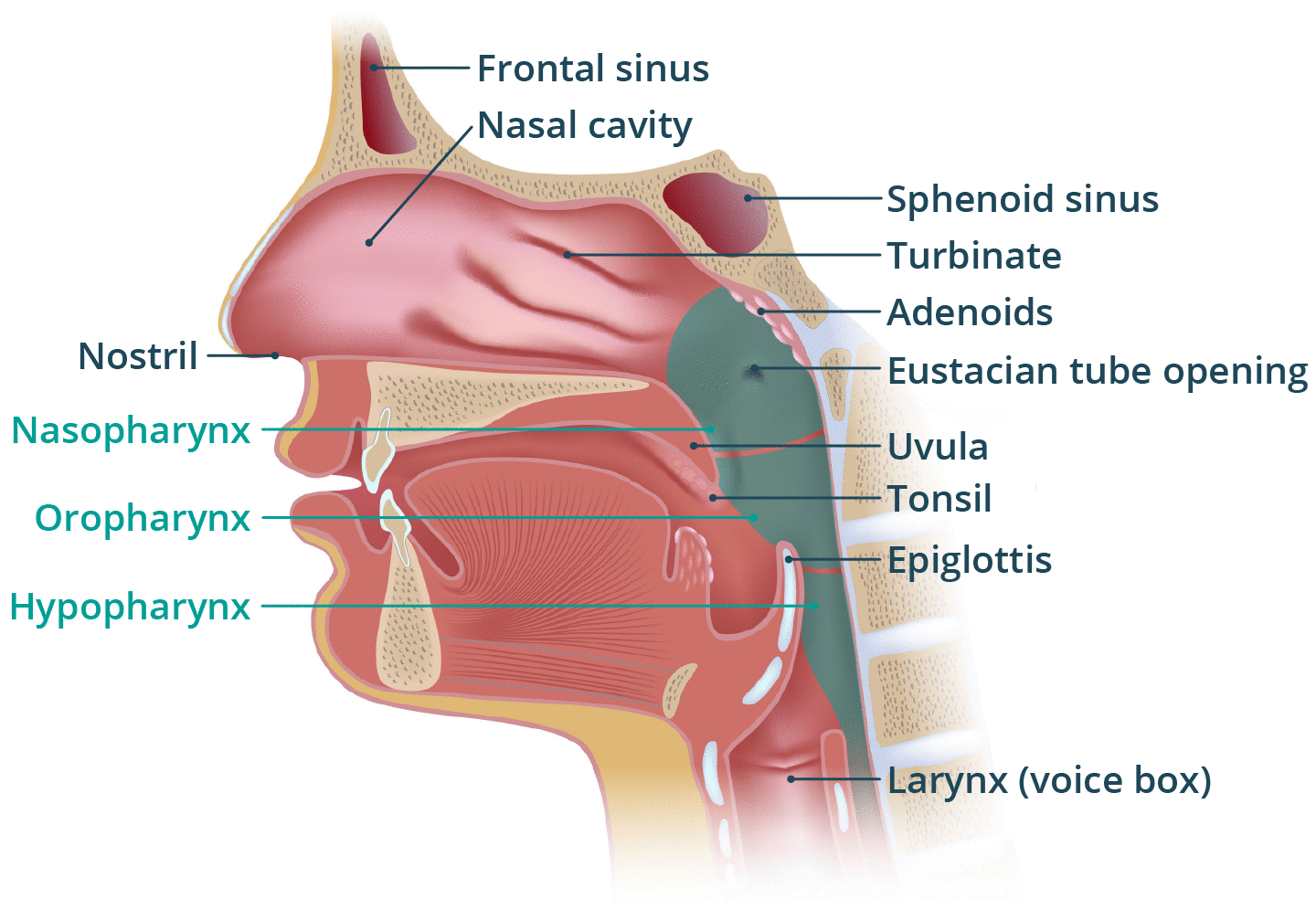
You experience this as a frontal headache, a runny nose/sneeze, a tickled throat, even a full ear (via the eustachian tube opening in the throat).
The 4 Stages of a Cold
Once the above scenario has occurred, the body embarks on the following 4 stages to get over this cold:
Onset. In this stage the objective is to restrain the fluid from premature evacuation.
Buildup. The objective here is to ripen or mature the fluids into something that the body can easily expel.
Peak. Once ripe, the fluids can now be safely discharged.
Recovery. Support the body and correct the constitutional disturbance that allowed this problem to occur in the first place.
The counter-intuitive key to the process is to prevent discharge until the fluids have matured into that which is appropriate for expulsion. Otherwise, they may move into and get stuck in locations which can cause further complications.
For instance, the movement of a head-cold into the chest and the bronchitis or pneumonia that may follow. The extended cough that lingers after the head-cold has resolved.
Both Unani and Ayurvedic medicine attribute chronic sinus and chest problems to be a result of premature suppression or purgation of these fluids.
Stage 1 - Onset
In the summary charts that follow, you will notice that there are two types of “colds” or catarrh (buildup of fluid) - hot and cold type.
For the sake of this example, we will discuss the cold type.
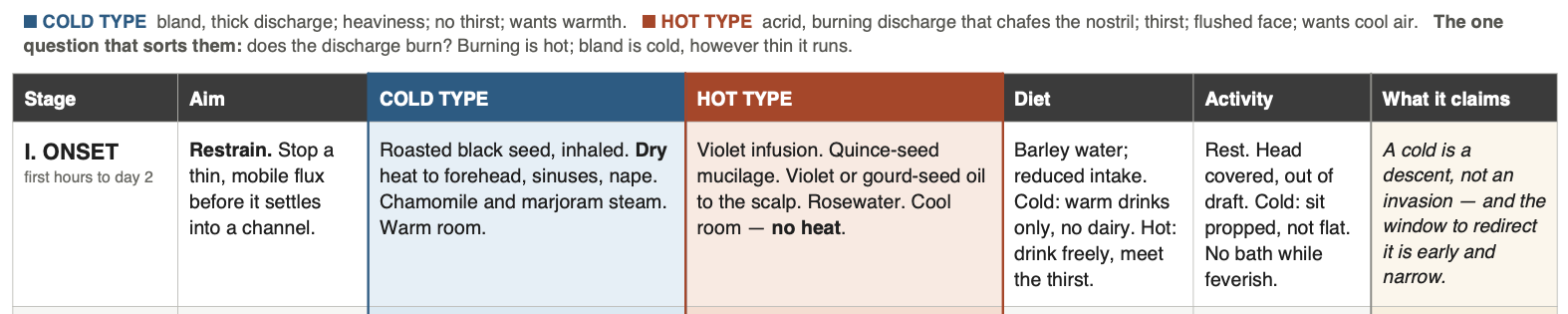
Stage 1 is a relatively narrow window, requiring immediate and appropriate action so that we minimize complications, and optimize the speed at which we recover. Timing is everything.
In reality, stage 1 is not necessarily distinct from stage 2. You can think of them as two sides of the same coin. Stage 1 buys you time while Stage 2 does its thing.
As you may have guessed from the opening description, I failed to act appropriately at stage 1, and am now paying the price with a lingering cough. And, in hindsight…this was a common series of events for me.
Paid Subscriber Benefits
Monthly Live Q&As
Podcast Episode Early Access
Complete Essay Archive
