



Recently, I was asked to provide our newly graduating trainees with a lecture on job-selection. Most of the time, lectures on this topic concern themselves with:
Academic vs Private Practice
Salary + Benefits
Vacation Time
Of course, this is in the context of medicine…but many of these considerations translate to other industries. Just replace Academic with “public” and Private Practice with “corporate.”
Regardless of where any of us choose to work, if there is an HR department…we will be inundated with information about burnout and techniques that can be used to mitigate it.
Often times, these techniques involve things that are to be done outside of work.
Meditative practices
Social connection
Time away from work
Don’t get me wrong, these things are incredibly important.
In some industries, they’ve even tried a combination of reducing work hours or increasing pay.
Unfortunately, this has not been very successful. Burnout continues to be a leading cause of attrition in the workplace. Most recent statistics suggest that even radiologists (previously one of the most satisfying specialties in medicine) have a 50% chance of leaving their current job within a 2-year span.
On the face of it, this article is about burnout at work.
But on a deeper level, this is about blowing the fuse in your head - both physiologically and psychologically. In fact, the term burn-out is quite appropriate here…as is the idea of a blown out fuse.
There is another visual that we can keep in mind whilst we discuss the cause and nature of burnout.
Rising load → Compensatory mechanism → Instability → Crash.
Let’s use a couple of common experiences to illustrate.

Have you ever run a graphic-intensive software on a computer? At first it seems like the rendering is going fine, but at some point…things start getting choppy, pixels glitch out here and there. Until eventually…the computer crashes.
Or…you ever found your internet browser has 100+ tabs, and you opened that insanely large spreadsheet from work…only to find that your system is becoming less responsive? All that memory and processing bandwidth has been clogged up. The computer tries to compensate…heats up…and…crashes.
I think you get the picture. But, there is something deeper in these examples that hauntingly echoes what happens to humans under stress.
I emphasize ‘stress’ because often it’s understood from 2 seemingly distinct perspectives. Either physiologic stress (e.g. adrenaline, stress hormones) or psychologic stress (the subjective experience of being ‘stressed’).
What the above examples should hint at…is that there is a direct connection between these phenomenon.
Broadly speaking, depending on how you run your software…you can burn out your hardware.
Before we get into how this manifests, it’s important to understand a few basic concepts about routing and transformation of energy.
First, all of life is the movement and transformation of energy. This energy is used to order the material of our organs and bodies. It’s used to carry out the functions of our body parts. And it’s used to perform the actions or outcomes we desire.
Second, the movement of energy is optimal when it occurs in pulses synchronized to its use and eventual loss. That is to say, if you pump too much electricity through a circuit into a light bulb…the filament can overheat and break. The input was not matched to use and output.
Since energy can neither be created nor destroyed, this synchrony is of great importance.
Finally, we need to avoid recursive traps of energy expenditure for two reasons:
We will eventually starve other parts of the system from the energy input.
We will overwork the upstream input mechanism.
For example, if I run a bitcoin-mining algorithm or heavy 3D rendering software…I cannot use my computer for any other function. At least not without getting annoyed. Furthermore, if this process runs for too long (and without appropriate cooling off) the computer will crash…and maybe even the hardware will burn out completely. Like a blown fuse.
Let’s take this back to the burnt out human to understand how and why burnout manifests, what it signifies, and how we can hope to prevent it.
Humans In Action
Let’s continue this discussion with the industry I’m most familiar with - medicine.
There are several trends in the medical field that are worth considering, at least in the USA.
For instance, there has been decades long trend of reducing reimbursements for medical services rendered. It’s only a few percent per year, but even across a short 10-year career…that’s a lot. For instance, a 3% reduction per year results in a net loss of 15% by year 10. This loss is also amplified by annual inflation and increased costs of goods/services. But, this article isn’t about finance.
This is one pressure on the job market.
Another pressure on the market is increasing rates of chronic disease and dependence on healthcare services.
Yet another is increasing use of technologies which depersonalize the human interaction (e.g. electronic health records, tele-medicine), and attempt to automate/scale an industry that is inherently unscalable.
What are we left with?
Doctors who:
Are pressured to make more money to stay still in life
See more patients because of the above and market demand for healthcare services
Less-and-less human interaction
Both the increased workload and decreased human interaction are really important.
When workload goes up a few things happen:
Doctors spend less time with a patient → less likely to figure out the real problem → even less likely to affect the appropriate change needed to heal
This increased likelihood to make an error hangs in their mind for days and weeks to follow
“What if I made a mistake? What if I missed something? I hope the patient didn’t get worse…or hurt.”
When human interaction goes down, the doctor also gets hurt.
Whether you are a primary care doctor or someone more introverted (like a radiologist or pathologist)…what is most predictive of work satisfaction?
Meaningful interactions with colleagues and patients. Direct feedback reinforcing the notion that you played a positive role in someone’s life today.
This is simultaneously a reward and a moment to relax - cool off.
Your work has made a positive impact. It has been felt. You can take a moment to breathe it in.
I think you can start to see the picture we are painting.
Recursive Pattern
Remember the analogy with recursive and high-demand software burdening the hardware to failure?
It’s important to understand just how energy demanding the brain is. At approximately 2% of body weight the brain consumes about 20% of available oxygen and requires a similar amount of blood perfusion.
The synaptic transmissions between the nodes of the brain are very energy intensive. It’s not just the autonomic biologic drive to survive and process information which consumes energy.
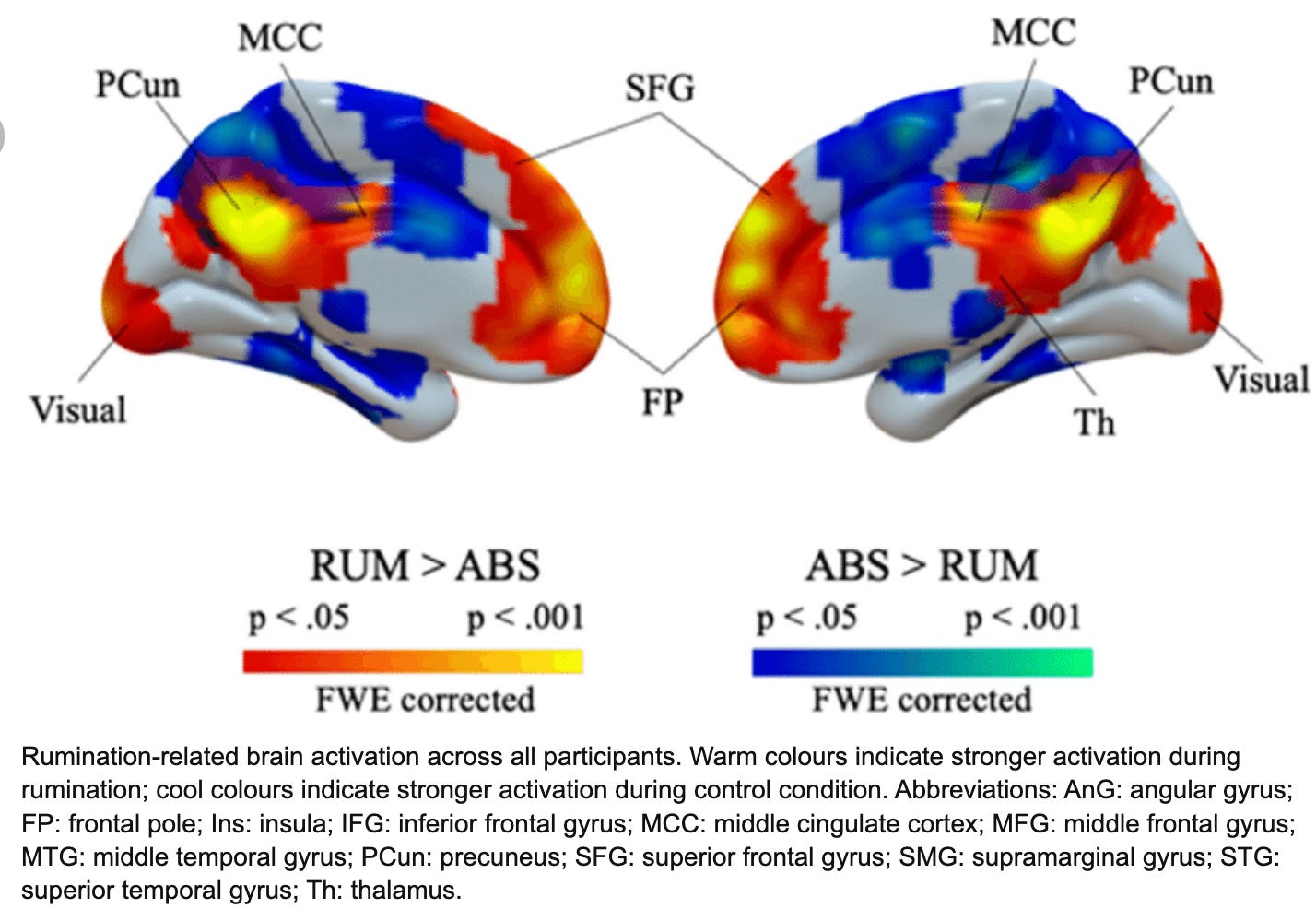
The landscape of conscious imagery, thoughts, fears, and emotions also drive up energy demands.
Now, imagine you are constantly thinking about:
How little time you have for your family
How little time you have to take care of yourself
Whether or not you missed something with last the patient you saw, because you were rushed.
What about the patient before them? And so on?
Did you spend all this time and money on education and training so you can satisfy the absurd demands of administrators?
These psychological phenomena and imagery (software) are running recursively in your head (hardware), constantly depleting you of precious energy and bandwidth.
You start losing sleep.
Getting irritable.
Making even more mistakes.
(You are starting to glitch).
And, eventually…you crash.
Welcome to burnout.
Your fuse has blown.
Unfortunately, humans are not a fuse box. You cannot simply replace a blown fuse and continue like everything is ok.

Even the humanoid robots in Westworld had remnants of their traumas haunt them with each new system reset.
Preventing Burnout
Preventing burnout isn’t that complicated.
The problem is that the answer is contradictory to the demands of our employers. Which is why you are constantly being bombarded by HR about the ultimately unsuccessful strategies they recommend.
The solution requires us to approach one of the 4 Pillars of Health: meaning.
Remember, the factor which doctors value most in their jobs?
Meaningful interactions with their colleagues and patients.
Meaning. Depth. Significance.
Not case volume. Not how they got paid.
It is long overdue to tend to the garden of our Souls.
A person’s dynamic with their workplace and employer will be unique to them.
But the common thread is they need to put the value of their soul, and the meaning of their work above all else.
This may be the perfect opportunity to plug my last interview in which we discuss this very topic: Tending to the Garden of the Soul.
This is a superb article. I have been thinking about this topic lately. I appreciate the way you have broken it down. Psychological and physiological, hardware and software, glitches, fuses, etc.
How do you attend to your soul, when you can barely attend to your body and all the other things going on?
I was just listening to a podcast of two doctors who were discussing medical school and all the training and the abuse from higher-ups. Then they finally are done with their education and training and it's, "Okay, now... Go be a doctor." By that time, they are exhausted with their brains on overload and tired bodies and wondering, "What do I do now?"
As patients, we go to doctors with our laundry lists of symptoms and problems and hope the doctors can wave their magic wand and make us better. I have wondered how doctors can listen to many patients a day or a week and not go into another room and scream... Having all these patients with our questions and gripes is a little like a parent with 200 kids all wanting something right now.
I believe the medical system needs drastic changes in how it works. That's a really tall order. Doctors need to be self-employed and not have to work for the corporation and its shareholders, as well as the pharmaceutical companies. People need to break away from the “healthcare” system, and they don’t know how and are terrified of putting their health in their own hands. Most people won’t do something if insurance doesn’t pay for it. They can’t afford self-pay so they keep engaging in disease-maintenance systems.