


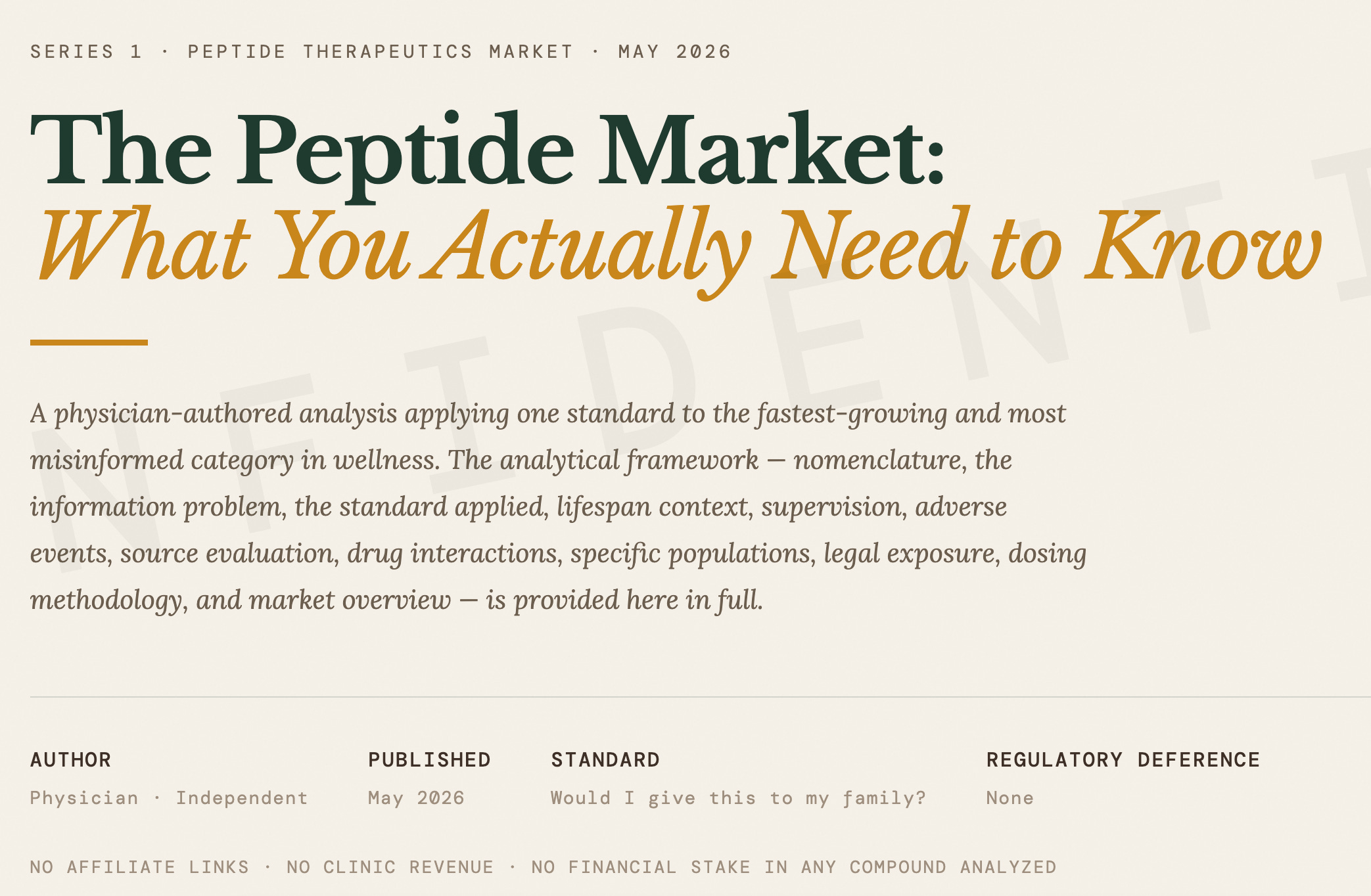
I want to show you something I’ve been working on.
A couple of weeks ago I started keeping a personal research file.
People were asking me about peptides constantly, and the more I looked at what was actually being written about them, the more troubled I was. Not because the compounds are necessarily dangerous. Because the information environment around them is almost entirely conflicted.
Vendors running “educational” blogs on the same domain as their store. Longevity clinics whose revenue depends on patients staying on protocols. Influencers presenting themselves as spokespeople for these products. Researchers with deep institutional ties to the compounds they publish on. Even the “educational resources” have a financial stake in how you perceive these products.
So I started applying a different standard. The one I use for anything I’d recommend, to anyone. The standard is simple: would I give this to my own family?
That standard has many effects:
It disqualifies “the preclinical data looks promising.”
It requires saying out loud when a Phase 3 trial failed.
It requires treating a cancer signal from a mechanistically identical pathway as a risk worth identifying.
It requires acknowledging that most endocrinologists have not been thoroughly educated or trained about the compounds their patients are injecting.
What started as a personal file quickly became a comprehensive research dossier. What I’d want to exist if I were a patient or a physician. My main thesis is that the term “peptide” is strictly marketing, and not an indicator of anything meaningful about the product.
Once you realize this, the house of cards collapses, and everything else follows including the information problem, what responsible supervision should look like, how to evaluate whether the compound you ordered is actually what it claims to be, and a full compound-by-compound analysis of the top peptides in the market - which include the following information:
Strength of available literature
Current regulatory status
Third party testing of contents compared to manufacturer claims
What is the sequence of the peptide
What is it most similar to in the body
What is the mechanism of action
What are risks associated with the biological pathway that is regulated by this peptide
What is the natural history of this peptide in the body, including as we age
What disease states and lifestyle factors modulate the body’s version
and more…
This is a glimpse into a pet project that has slowly turned into a major undertaking…and I want your honest feedback.
Here is what I’m asking: read what I’ve built so far. Tell me what’s missing, what’s wrong, what’s unclear, and what resonates. You are the people whose opinions I trust enough to show this to before it’s done. If you find a factual error, I want to know. If the standard I’m applying is too conservative, make that argument. If there are gaps — compounds I’ve missed, risks I’ve understated, questions I haven’t answered — tell me.
What you have access to here is a PDF version of the work-in-progress. The final peptide dossier will be a navigable stand-alone webpage.