



Article: An experimental study on the effect of different types of textiles on conception.
Context
Plastics are ubiquitous, and for good reason. They have improved our lives in ways which we cannot begin to fathom. From the industrial to the personal day-to-day, plastics have touched everything.
As with all things, however, there are downsides. Whether to the environment (enabling mass production, consumption, and waste), or to our bodies in the form of BPA and Phthalates.
Researchers have been warning about the use of plastics in everyday life for decades, including those who present rather convincing data suggesting hormonal impact of plastics via estrogenic disruption.
In the digital health-hacking biosphere, avoiding exposure to hormone disruptors has become a hot-topic issue. Whether the concern is about the impact of estrogens on overall hormone regulation, cancer, or fertility.
The study we are about to discuss explored the impact of different textiles on the hormonal cycle and fertility of female dogs (bitches). Based on their results, our fears are supported…but, not for the reason we were expecting.
More pressingly, it seems that the impact of polyester on fertility impacts both men and women.
Recently, I stumbled the work of a surgeon from Cairo, Egypt: Ahmed Shafik.
Shafik has performed some very interesting experiments on both dogs and humans, as pertains to fertility.
The study linked above is of particular interest, as female infertility seems to be on the rise.
Study Design
The authors chose 35 bitches who are otherwise known to have normal reproductive cycles and have conceived when mated.
These 35 were split into 5 groups: 4 experimental groups and 1 control.
Four Experimental Arms:
100% polyester pants
50/50% polyester/cotton blend pants
100% cotton pants
100% wool pants
These pants were fashioned such that they cover the pelvis of the dogs, including the lower trunk, perineum, and upper hind limbs.
The dogs wore these pants day and night for 12 months. After completion, the pants were removed and the bitches were followed for an additional 6 months.
During the study period, Shafik performed hormonal assays and attempted to mate the dogs. They attempted mating both during the 12-month period and the post-pant-removal 6-month period.
The hormones (estradiol and progesterone) were assayed both in the estrous (fertile) and anestrous (infertile) phase.
As the name suggests, pro-gesterone is a pro-gestation hormone and is critical in fertility.
One more thing: Shafik also studied the electrostatic potential generated on the skin by the cloth that was worn. More on this later.
Results
With respect to hormone dysregulation, the only robust finding was this:
Bitches who wore polyester or polyester-cotton blend pants experienced an order of magnitude drop in progesterone.

More importantly, this drop in progesterone was noted in the estrous phase, the phase in which progesterone is needed most. This is why in the first 2 columns (anestrous phase) progesterone is already low.
Even more convincing is that the progesterone levels normalized after removal of the polyester pants.
But, wait - there’s more.
Out of 14 bitches (7 polyester and 7 blend) that worse polyester-containing pants, 8 were unable to conceive during the 12-month period
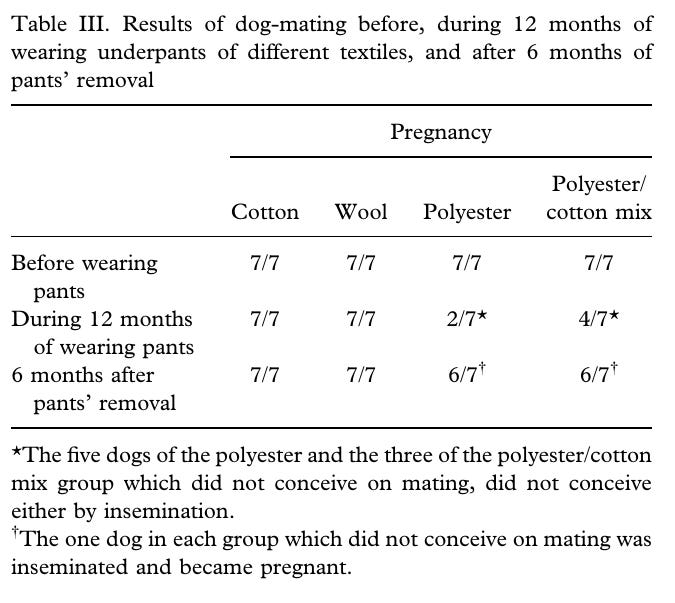
Based on this admittedly low-n cohort, it would seem that the effect of polyester exposure is dose-dependent. Meaning, the more polyester in your pants, the greater the impact on fertility (second row). Now, this may just be a fluke of low-numbers and not really dose-dependent.
But, the final outcome that Shafik tested further supports dose-dependency.
That final outcome was skin electrostatic potential.
For those who are unfamiliar with physiology, we are electric beings (as are all forms of life). Despite what the mainstream will tell you, electrostatics does have an impact on physiology - and not merely ionizing radiation.
We are batteries, and it is long past due that we treat ourselves like it.

Notice that the change in skin electrostatic potential is greater with higher exposure to polyester. Cotton and wool? Completely inert.
Shafik believes this may be due to the friction between polyester and skin which results in a charge-separation resulting in increased net positive electric charge on the surface of our skin. The exact mechanism of this is yet unclear, and the field of triboelectricity has emerged to understand the nature of charge-separation between surfaces. More on this in a future article.
Thus, it may be the case that a rather durable polymer like polyester is not seeding estrogen disruptors into your body…but rather altering the electrostatics on the surface of your body, which will inevitably have an impact on electrostatics inside you.
What about Males and Humans?
In 1993, Shafik also performed a similar investigation on male dogs.
24 months of continuous wearing of scrotal underwear, half with pure polyester and half with pure cotton. He was also careful to monitor the temperature, because we know that this can also have an impact on sperm count and quality (in humans as well).

Notably, after removal of the pants only 10 of the polyester wearing dogs returned sperm count to normal. Two remained with low sperm count.
Not only was sperm count low, but sperm motility was impacted drastically. Sperm motility with polyester pants plummeted. Similar to the sperm count, motility did not recover in all dogs.

Even more concerning, sperm morphology was impacted:

In a separate study, Shafik demonstrated that polyester again produced an electrostatic charge on the scrotum. Upon biopsy of the testicles of these dogs, they found that the tissue had begun to degenerate and die.
In 1992, Shafik, Ibrahim and El-Sayed performed a test of electrostatics on human scrotums.
21 healthy men were given polyester, polyester/cotton and pure cotton underwear. They did not wear these pants for months on end.
They only wore these pants from 10AM-12PM and 8PM-10PM. This was designed to simply test for electrostatic changes, not to make these men infertile.
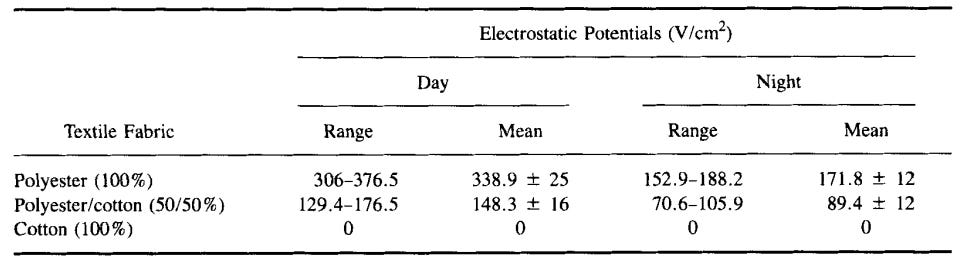
Again, we find a dose-dependent change in electrostatic potential on the surface of the scrotum. Not seen with pure cotton.
But, what about male fertility?
Well, Shafik has you covered.
In 1992, Shafik performed an interesting experiment in which he attempted to test the contraceptive efficacy of wearing a polyester scrotal sling. The female partners were on contraception until the males demonstrated a third consecutive result of azoospermia (very low sperm count). After this, the females stopped using contraception.
All male subjects became azoospermic, on average within 140 days of sling use. After 6 months, the seminiferous tubules showed degenerative changes and sloughing (similar to the dogs).
No pregnancy occurred during the 12-month period.
Return to normal sperm-count took on average 156 days.
In Closing
These are some of the most interesting experiments on fertility I have encountered, and not surprisingly, almost all of them were performed in the 1990s.
Unfortunately, Shafik seems to have abandoned this research, and does not publically list them on his online profiles.
However, this is only one organ system.
What are the effects of other charge-carrying substances that we unknowingly encounter?
What sort of long-term dysfunction are we causing ourselves?
To be continued…
Doc, as interesting as this topic is and there is sufficient research out there for quite some time now that shows the health consequences of both macro and micro plastics, the issue of female infertility apparently on the rise is also related to the global mass experimental injection campaign or worse being aggravated by it? Just a thought.
Well reported, thank you for your continued work