


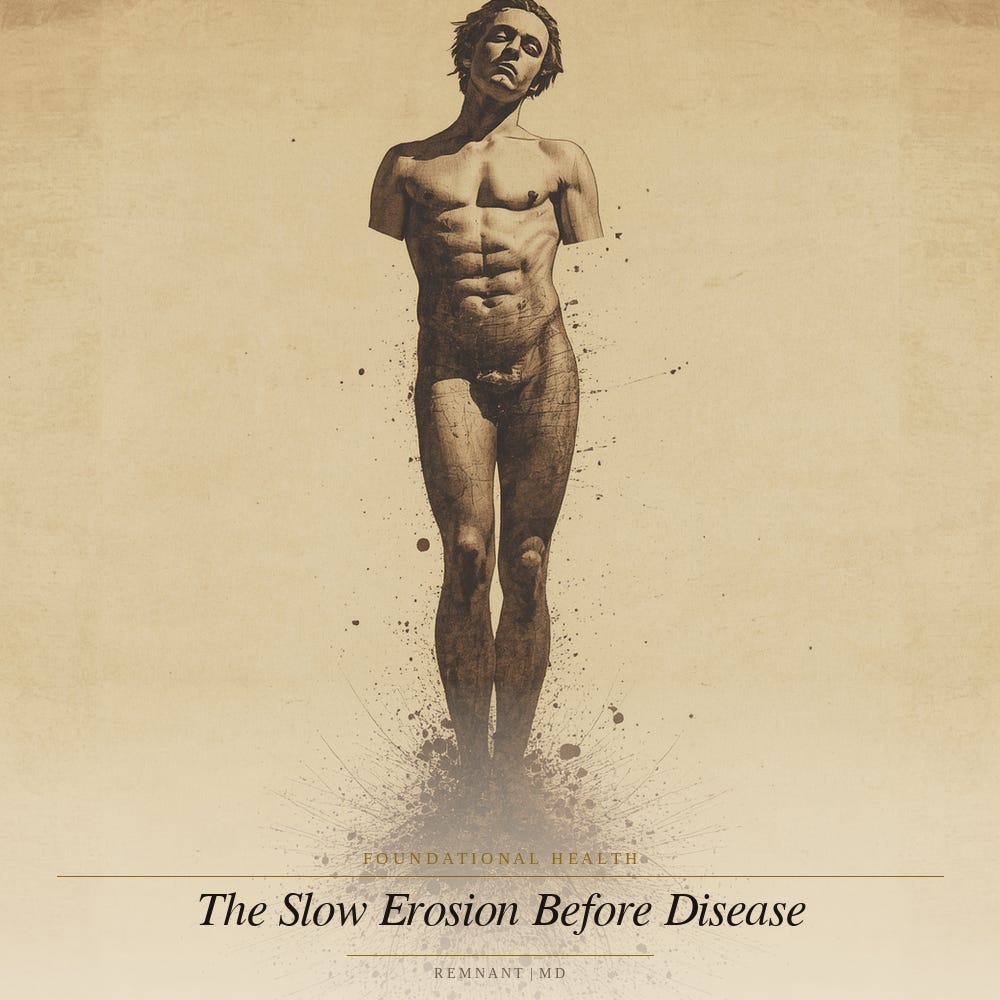
A Disrupted Balancing Mechanism
Most people understand disease as an event.
Something arrives. A label is assigned. Treatment begins.
But the diagnosis is not the story. It is the moment the story became difficult to ignore.
The body is not passive. At every moment it is working to maintain internal stability against an environment that is trying to destabilize it. Temperature. Blood sugar. Inflammatory stressors. Hormonal cycling. This is called homeostasis. And health is not the absence of these stressors, but the capacity to resolve them.
Disease begins when that capacity erodes.
Not when blood sugar fails to return to range once. When it consistently returns a little more slowly, until one day it stops returning at all. When inflammation occurs and never fully resolves, leaving a residue that lowers the threshold for the next activation. The body is built for perturbation. What it requires is the capacity to recover. Most people lose that capacity over years…in ways they attribute to aging, stress, or circumstance.
Modern medicine intervenes at the threshold. It has no framework for the decade before. It recognizes the destination, gives it a name and treats it. The question of how you arrived is not a billable event, and their answer is usually a drug.
A huge flaw in the model.
Low Hanging Fruit
If disease is the progressive failure of homeostatic capacity, then the conditions that produce it are mostly ordinary:
Sleep is when the largest share of systemic correction occurs.
Food is the primary input that either supports or overloads the metabolic systems responsible for that correction.
The environment is a continuous signal that either calibrates or disrupts the neuroendocrine regulation that governs all of it.
None of these are exotic. But, they are not the center of clinical practice because they are not scalable in a system built around managing threshold events.
Restoring homeostatic capacity is not generic. The intervention that helps one person return to balance will push another further from theirs. Universal protocols fail even when they are genuinely good protocols, because that balance is not the same for everyone.
This is what constitutional medicine understood…thousands of years before modern medicine dispensed the traditions from which it evolved. Before you can restore balance, you need to know what balance looks like for a given individual. Not for the non-existent average person in a clinical trial.
For you.
The first step toward health is not a protocol.
It is knowledge and understanding.
I used to think that the axiom “First do no harm,” was the correct starting point.
I now realize that’s incomplete.
First, know the patient. Know thyself.
Then, do no harm.
Or…Flourish.
Update on Temperament Assessment
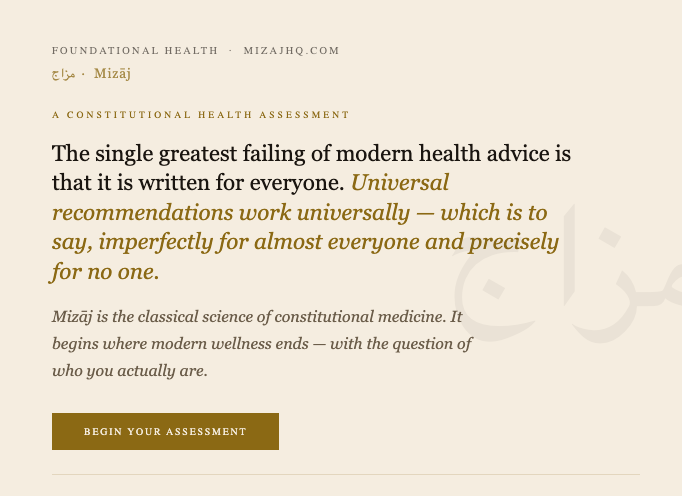
Some of you took the first version of the constitutional self-assessment last year. That was a starting point: four brief outputs, just a test.
What I have been building since is completely revamped.
After analyzing the initial cohorts’ results, I have made more precise questions, written in the language of how people actually experience their bodies rather than the archaic vocabulary of most constitutional frameworks.
Now, there are thirteen possible results instead of four.
1 balanced, 4 pure and 8 compound temperaments. Enough resolution to produce guidance that is genuinely specific.
And, the output is no longer a short description.
It is a complete constitutional reference manual.
Around 60 pages specific to your temperament, organized around the Foundational Health four-pillar model: Activity, Consumption, Habitat, and Meaning. Every section calibrated to your specific type. Temporal variation throughout: time of day, season of year, stage of life, and for women, the menstrual cycle across all four pillars.
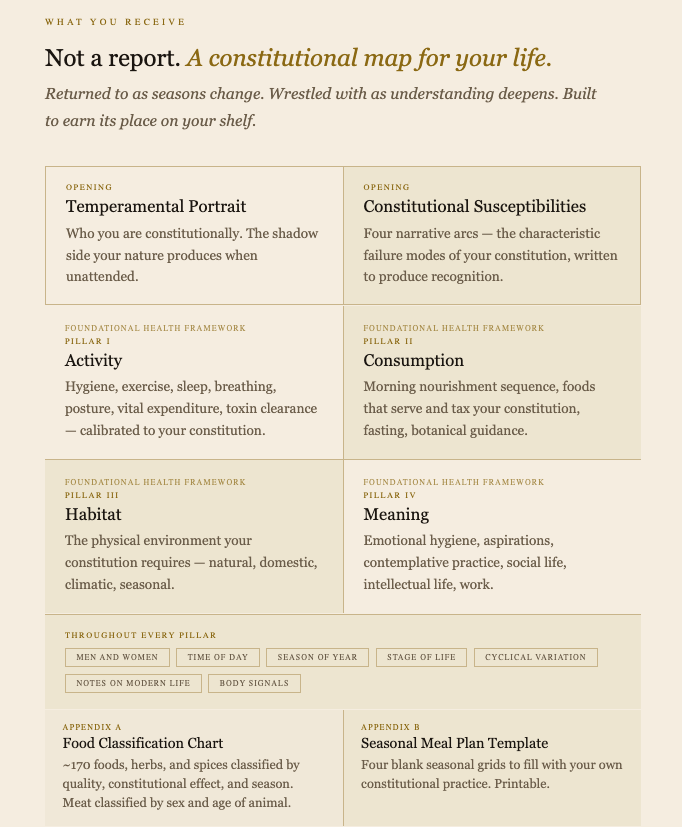
It also includes a food classification chart covering roughly 170 foods, herbs, and spices, classified by their constitutional qualities and seasonal appropriateness. This is accompanied by a seasonal meal planning template to fill in with what you know about your own nature.
The first report of this type is already done (for Pure Sanguine Temperament). I’m so pumped for you guys to see it.
I’m even thinking of offering a physical copy so you can have it sit in your kitchen, nightstand or coffee table. Returning constantly to calibrate and go deeper in your understanding of yourself.
Let me know in the comments below if a physical copy would be of interest.
Launch is coming! All subscribers will be notified when it’s ready.
Join the Journey
Monthly Subscriber Benefits:
Full essay archive.
Early podcast episode release.
Discounts on future products.
Foundational Assembly (Limited Members):
Advance notice of guests + submit questions before recording.
Join podcast recordings and ask questions directly!
Complimentary copies:
Temperament Assessment Personal Constitutional Report
Peptide Research Dossier
Books
May I add my name to the physical-copy-please team?
I'm so happy to see this! Yes, I would be interested in a physical copy.