



You find yourself at a “heart-healthy” screening event. You have no symptoms. No history of heart attack or stroke.
The doctor asks you a few questions, then recommends a coronary calcium scan - an imaging test that estimates how much hardened plaque sits in the arteries of your heart. The result is very distressing to the doctor, and so it becomes distressing to you.
From that single test, a cascade begins.
First, you are reclassified from healthy to being “at-risk.” Because now, you have “heart disease.” The doctor probably starts you on a statin that you will need for the rest of your life. He may also put you on aspirin. The high calcium score also invites progressively more invasive imaging. First, a coronary CT angiogram. Then, heart catheterization so they can personally inject your coronary arteries with contrast.
Doctor says something like “you have 3-vessel disease. Total blockage. You need a bypass.”
Remember, before all of this testing…you had no symptoms. Despite the fact that all your major coronary arteries were blocked.
Coronary Artery Plaque vs Heart Disease
When you look up “heart disease” you will find a few usual culprits.
Heart attacks
Heart Failure
Coronary Artery Disease (plaque)
Arrhythmia
Heart attacks, heart failure, and arrhythmias are all clinical syndromes. That is to say: these are things that patients experience and bring to medical attention.
Plaque, on the other hand, is not. The smuggling of plaque into the category of “heart disease” is something that most likely began as a misunderstanding…but persists because the vast majority of cardiovascular testing and treatment hinges on plaque. A billion dollar industry.
My argument is that plaque is simply a marker of heart disease…and in fact, an unreliable marker.
A marker is an indirect measurement that is hoped to predict the real outcome, in this case a heart attack. There is nothing wrong with markers in principle. The trouble begins when the marker that was meant to hint at the disease is treated as the disease.
And, as you can see from the contemporary definition of heart disease…plaque is considered to be heart disease.
But, the two are not the same.
Where This Hits Home.
My friend (in his sixties) experienced a scenario like the one above. In fact, his experience was almost identical.
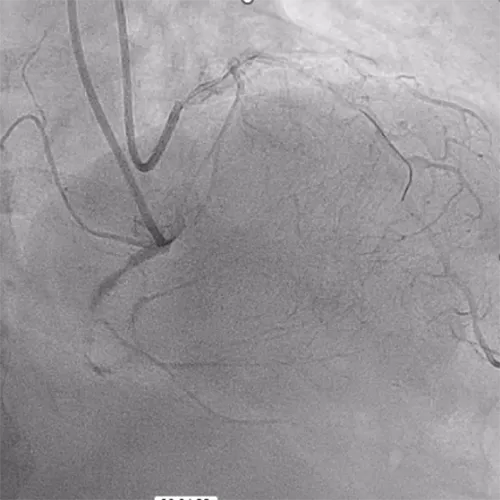
The first question you may ask is:
if all his arteries are blocked…how come he didn’t have any symptoms? That’s a good question.
The next question is:
if his arteries are already blocked…then what was the cardiologist trying to prevent?
Because the entire premise around opening narrow arteries is that you want to prevent a plaque rupture from causing a blockage of the vessel.
But…if all the major coronary arteries are already blocked…how could a plaque rupture possibly make it worse? In my friend, the reality is that the circulation had already rerouted itself through hundreds (if not thousands) of tiny collateral vessels the body grew on its own.
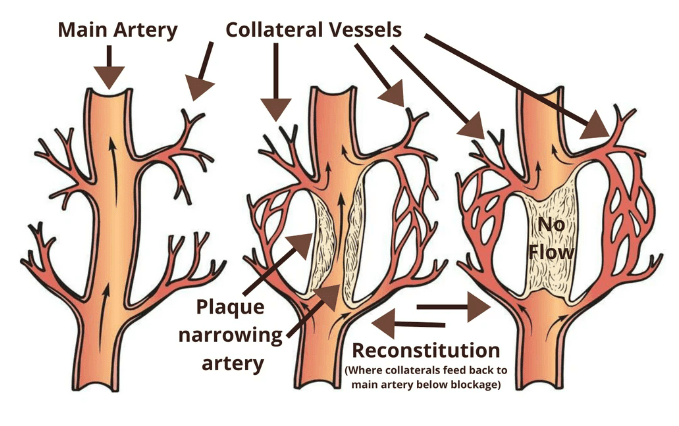
His body already bypassed the blockage. To suggest they need to bypass the blockage with 1 large vessel…is creating a scenario in which a clot could cause a heart attack. Because with this new bypass…you reroute heart perfusion through one failure point.
But, it doesn’t matter. Because plaque is “heart disease.” So, now we are in the business of treating the plaque.
But, Is Plaque Heart Disease?
In 1953, William Enos examined the hearts of 300 young American soldiers killed in Korea. Average age 22. No cardiac history. Died in combat.
He found plaque in 77% of them.
Later, the PDAY study found plaque already building in trauma victims aged 15 to 34. Further, an autopsy study of people who died of non-cardiac causes showed plaque in 46% of those in their forties, 65% in their fifties, 82% in their sixties, and 88% of those over seventy.
A marker present in 88% of people dying of an unrelated cause, without history of heart attack or stroke, is measuring something else. Maybe it’s simply a function of age. Plaque may be closer to grey hair. The marker is nearly everywhere. The disease is not.
Now, the argument that cardiologists will make is something like this:
“If these people only lived long enough, they would eventually die of a heart attack.”
Is this true? It’s a hard thing to refute, though it’s certainly a convenient assertion.
Let’s see…
One study looked at the rate of plaque in 3 elderly age groups: 80-89, 90-99, and >100 years of age. This study consisted of autopsy results from over 400 people.
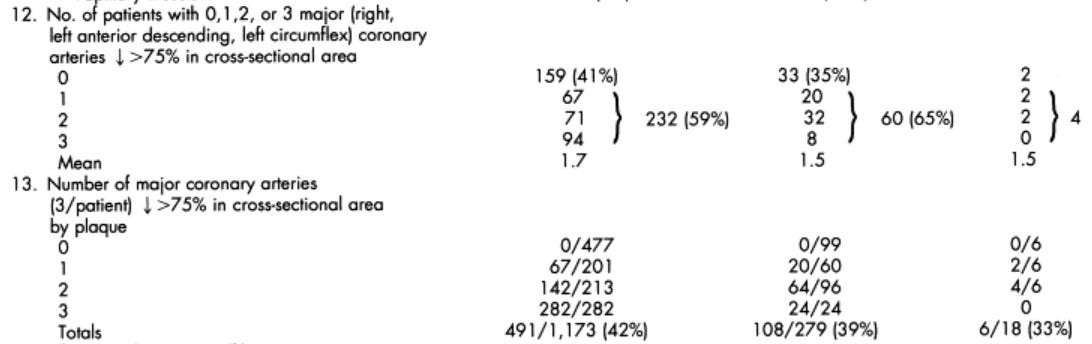
These people had various causes of death, but the important thing to note here is that the third column (>100 years old) had a similar proportion of coronary artery disease as those in their 80s and 90s.
None of the centenarians died of heart disease. And, those in their 90s were less likely to die of heart disease than those in their 80s (~30% vs 50%).
The pattern here is worth noting: despite the fact that all 3 groups had a similar degree of coronary artery plaque…heart disease was less and less likely to be their cause of death as they lived longer.
So the cardiologists argument doesn’t really hold up.
What it does support is the argument that plaque is merely a marker of aging. Aging means tissue has undergone stress and healing cycles. And the body lays down plaque as a way to heal.
Even amyloid plaque in the brain (alleged cause of Alzheimer’s) is seen in cognitively healthy and functional people who lived beyond the age of 100.
In fact, 35% of healthy centenarians had Amyloid-beta plaque in quantities similar to those with clinical Alzheimer’s Disease.
What Plaque Tells Us Beyond Aging
Another argument you may hear from people in the pro-plaque camp is that there are such things as unstable plaque. Which is true. An unstable plaque is one with characteristics which suggest this plaque can rupture at any moment.
A small unstable plaque can kill. A large stable one does not. Here we have yet another piece of evidence showing us why plaque burden (or volume) is not what we should be worried about. Plaque volume says nothing about the stability, and the calcium score is even worse because calcium is what makes a plaque hard and stable.
So the real question is: What makes a plaque unstable? More on this later.
Consider this paradox, which is the clearest sign that the field is protecting its premise. Two people with calcified coronary arteries. The first is untreated and asymptomatic, just like my friend. His calcium is interpreted as a risk, a reason to start treatment, and even operate.
The second has been on a statin for years, and his coronaries have gotten more calcified during this period. That rising calcium is interpreted as success: the drug is working, the plaque is stabilizing! Same substance, same artery, same measurement, but its meaning flips depending on treatment status.
There is a real physiologic story for that second person. Statins can subdue the hot, inflamed, dangerous plaque. As the plaque cools down, it hardens and mineralizes. Rising calcium alongside a falling inflammatory signal is the picture of a lesion converting from dangerous to safe. That is a perfectly coherent mechanism.
But notice what it does to the marker. If rising calcium can mean a patient is getting better, then calcified coronaries does not = heart disease. At this point, you should start to see the cracks in their reasoning. And we’ve only just gotten started.
When We Treat By Plaque Burden
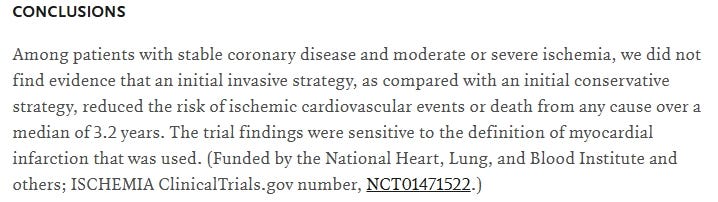
What happens when you treat the marker directly? If plaque volume were the disease, clearing it should save lives. Two of the largest trials ever run, COURAGE and ISCHEMIA, took thousands of stable patients with narrowed arteries and gave half of them stents and half medication. The stented patients did not live longer or have fewer heart attacks.

You can remove the blockage, lower the plaque burden, and survival does not change. My friend got a procedure that does not extend the lives of stable patients like him.
Then there are cases of heart attacks with barely any plaque present.
In about a third of the most serious heart attacks, the culprit plaque does not rupture. Instead, the artery’s delicate inner lining simply wears through and the raw surface beneath it triggers a clot.
There is another mechanism known as spontaneous coronary artery dissection. This mechanism is estimated to cause anywhere between 25-50% of heart attacks in women under 50.
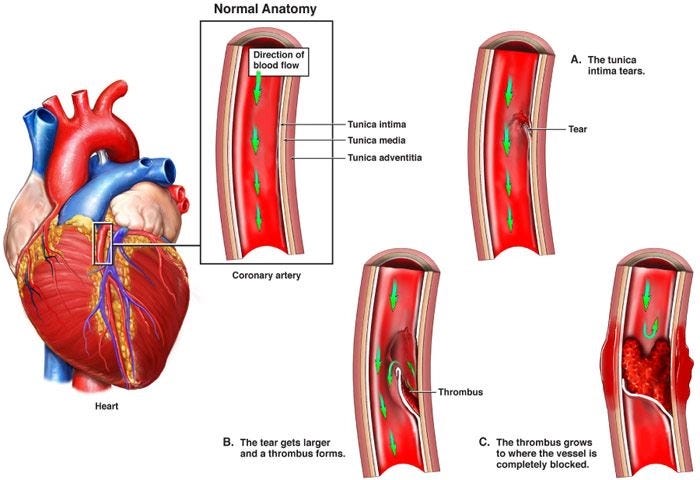
Another path to a heart attack is by coronary artery aneurysm. The artery can balloon and let blood stagnate and clot. Or, an aneurysm can also lead to a dissection.
Yet another is a heart being stunned into failure by a flood of stress hormones while the arteries are entirely clean. This is a syndrome known by many names including broken heart syndrome, Tako-tsubo cardiomyopathy, and apical ballooning. I mention this because it’s an example of catastrophic neuro-hormonal stress overload, and leads to the next cause of plaque-independent heart attacks.
Modern life is an endless cascade of stimulation and stress, which puts chronic high stress (sympathetic) on the heart. This prevents it from resting and recovering (parasympathetic). In fact, many of our traditional preventative plant medicines (such as ouabain and galangal) have been successfully used to prevent heart attacks by promoting parasympathetic rest.
Which brings us to the crux of it all.
What does unstable plaque, coronary dissection, and coronary aneurysm all have in common?
You guessed it.
Inflammatory stress.
Inflammation can be measured with a blood test called hsCRP.
In a landmark trial called JUPITER, over 17,000 people with high hsCRP but without high cholesterol were given a statin to see if it would impact their risk of heart attacks. This was given to people who are otherwise healthy, to see if they experienced a first major cardiovascular event.

PET imaging that lights up inflamed, metabolically active plaque shows that statins reduce the inflammation within weeks, and often before the plaque changed at all. Thus, even the flagship plaque drug is working on inflammation.
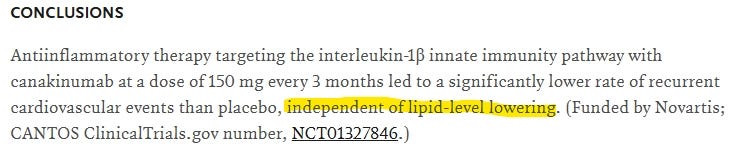
Furthermore, if you block inflammation directly with a drug that does nothing to cholesterol or plaque…we see a reduction in heart attacks. This is what the CANTOS trial showed using an anti-inflammatory monoclonal antibody, given once every 3 months!
Another trial was conducted using a cheap gout medication called colchicine, given to people who already had a heart attack.
And, guess what? Reduced risk of a repeat cardiac event. Keep in mind, this study was sampled from a patient population in which the vast majority were already on a statin. So, the colchicine is impacting the people who had heart attacks despite use of a cholesterol-lowering drug.

What’s fascinating and even more telling about this industry, is that when statins turned out to help patients with normal cholesterol but high inflammation, they conclude that hsCRP should be used to decide who should get the statin!
Think about what that means. Because in all of medicine, patient selection is everything.
By checking for inflammation, they select for people who respond to reduced inflammation. The net effect of this will be to magnify the perceived efficacy of a cholesterol-lowering drug. Further justifying the use of plaque targeting drugs. When in reality, it is the inflammation and stress which is the culprit.
Because as history has shown us, whether its regarding atherosclerosis or hypertension…the guidelines shift to include more people in the treatment paradigm, not less.
Thus, they are selective in the clinical trials when they want to give the impression that the treatment is effective. But, they use this magnified efficacy to prescribe the treatment to a wider band of the population.
Alas, this industry has a lot of capital behind it…and it seems that the practice of cardiology is pot-committed to this assertion about plaque.
From decades of observational studies, autopsies and clinical trials…it is clear that plaque is a marker of heart disease.
Frankly, it’s not even a good marker.
The word plaque conveys judgement.
When you hear the word “plaque” what comes to mind? Gunk on your teeth that need to be scraped off? Sediment in some piping that needs to be cleared?
The word “plaque” is evidence of a lifetime of bad choices. It comes loaded with guilt. So when someone tells you “you have plaque,” it comes off as a verdict against how you’ve lived. This motivates you to accept whatever intervention reduces it. The fear is entangled with shame, and shame makes you compliant.
But, what if we called it something else?
Why not, a scar?
After all, plaque is the end-result of damage being healed. Frankly, without the ability to lay down plaque your blood vessels would be a disaster. A hellscape. Constantly throwing clots or hemorrhaging.
What happens as we get older and get cuts and scrapes? We develop scars.
Of course, in the wrong environment (one that is toxic and inflammatory) even a skin scar can ulcerate and eventually become cancerous. But, under healthy conditions the scar simply remains.
So next time you hear someone say plaque…remember, it’s just a scar.
A marker of getting older and having experienced life. For better or for worse.
Wow - thank you for this. What a great explanation. I especially like the high hsCRP low Cholesterol intervention study. As someone who has calcium in their LAD (I'm 59), found 2 years ago. I was not happy to see this "healing" and at the same time was thankful that my body was able to "heal". I am very active with great blood flow, strength, endurance and overall health. I would not get additional testing and plan on avoid the "Sick Care Complex as long as I can.
As usual, just pass out the drugs without any investigation as to what may be causing the need for drugs. There has to be root causes for any affliction. Something happens over time to cause these conditions and modern medicine doesn't have a clue. Thus, taking a drug for any reason does not address what caused the need to take the drugs in the first place. That is not health in my book.